
How I got here
The rooftop
This is the day I thought I was dying, and the fear that followed me home.
In December 2022, a few days before Christmas, smoke got into our meeting room. There was a fire somewhere in the building. It wasn’t a big one, but the smell was strong, and we had to leave the floor.
I went up to the carpark rooftop to get some fresh air. That’s when it hit me.
I couldn’t breathe properly, and the harder I tried, the worse it got. My chest went tight. My heart was pounding.
I broke into a cold sweat, and my whole body started to tingle and go numb. I was sure I was having a heart attack.
There was only one other person up there, a stranger. I called out and asked him to get me an ambulance.
Then I lay down on the ground and tried every position I knew: lying flat, the recovery position I learned in first aid, sitting up, leaning forward. Nothing helped.
The ambulance took maybe ten, fifteen minutes. It felt like forever. The stranger stayed by my side the whole time, and I lay there coming to terms with the idea that this could be the last day of my life.
All my life I thought I was ready to die, but in that moment I knew I wasn’t.
In my head I kept crying out: What happens after I die? I don’t want this to be the end. I’m not ready. I’m not ready.
The ambulance finally came. The paramedics put an oxygen mask over my face to help me breathe, but I couldn’t stop hyperventilating.
At the hospital they ran their checks. Even then, I was still out of breath every time I tried to speak.
After a thorough check, they discharged me. Nobody told me what had just happened to me. No name for it, no explanation, no clarity.
The hospital gave me some pills. When I got home I googled them, and they were for anxiety. I remember thinking: anxiety? What’s that? Whatever. Maybe it’s a one-off thing.
It wasn’t a one-off.
It was only later that I found out the name for what happened to me on that rooftop: a panic attack. I want to stop on those two words for a second, because I know how they sound. Most people hear “panic attack” and picture someone a bit stressed who just needs to calm down.
That is not what it is. A panic attack hits your body with real physical symptoms: a racing, pounding heart, a tight chest, not being able to breathe, cold sweats, numbness. It copies a heart attack so closely that I was sure my heart was giving out.
My body was telling me, with everything it had, that I was dying. I was fighting for my life, and every second felt like death.
It came back, everywhere
And the panic attacks didn’t stay on the rooftop. They came back at a barbecue, and while driving with a friend.
They came in the queue for food, in the shower, from the smell of perfume, watching the TV show How I Met Your Mother over lunch, and in a meeting at work.
It happened at work so often that I can still remember every single toilet where I ended up on the floor, crying my eyes out and praying it would all go away.
Slowly my world got smaller. Every time I tried to drive, an attack came. Walking any distance brought one on. Even seeing my heart rate go up on my watch was enough to set one off.
So I stopped driving. I stopped walking anywhere far. I was scared to leave my room, and then it followed me into my room too. There was nowhere left to escape.
My body
My body was a mess. I was always on edge and short of breath. My head felt like it was being squeezed all the time. I sweated so much that I lost 8kg in a month.
I checked my heart rate on my watch all day long. I ended up in hospital twice, from medication side effects and from all the salts my body had sweated out.
I lost count of how many times I went to the doctor, convinced something was wrong with my heart.
Heart tracing, normal. Heart scan, normal. Stress test, normal. A month wearing a heart monitor, normal. And I would still sit there thinking: okay, but convince me I’m fine.
My birthday
On my birthday that year, my wife organised a surprise party. Our friends were in the living room celebrating.
I was stuck in the bedroom for three hours with rolling panic attacks. One would hit, my body would just about recover, and then the next one would come, and then another after that. It’s one of the worst things I’ve ever been through.
I couldn’t go out to join them. That’s how trapped I was.
The names, and the root
Eventually the doctors gave it names: panic disorder, PTSD, generalised anxiety disorder, health anxiety. On paper they’re just labels. Living inside them, it felt like the walls were closing in until it was just me and my fear.
Therapy helped. It took the edge off the symptoms. But after months of struggling I finally saw what was underneath all of it, and therapy couldn’t touch that. I was terrified of dying.
To understand why that fear hit me so hard, you need to know who I was before the rooftop.
I was Catholic, technically. If you’re new to all this: Catholic is the biggest branch of Christianity, and and are the other two. More on them later. I went to church once in a while. I knew about Jesus. But I never really understood what it meant to be a Christian, or to follow him.
Looking back, I was a Christian by culture, not by conviction.
I had been working since I was seventeen and never really stopped. There were bills, and there was family to look after, and by the time of the fire I was burnt out.
Faith was just something in the background. It was a habit I had grown out of, not a truth I had actually weighed.
And honestly, I thought that was enough. If you had asked me, I would have told you I believed in God and I wasn’t scared of dying.
Then I came face to face with death on that rooftop, and it was a completely different thing. I wasn’t prepared for it at all.
A faith I had never really looked at had nothing to hold me up when I needed it most.
I don’t believe things easily
This is how I tested every belief the same way, starting with whether Jesus even existed.
I’m a skeptic by nature. I don’t take anything on anyone’s word. If you tell me something is true, I want to know why.
Then I want to know why that is true. I don’t stop at the first answer, or the second, or the tenth.
So when I finally saw that my real problem was that I was terrified of dying, I didn’t go looking for something to make me feel better.
I wanted truth, not just comfort. Is there life after death, and is there any real evidence for it?
I didn’t give up, and I didn’t let up. I studied Islam, Buddhism, Hinduism and secular philosophy.
I asked what science says happens when we die. I read about reincarnation cases, simulation theory, near-death experiences. I was scouring the internet for answers, and I kept digging, and digging, and digging.
But I didn’t want to just pick whatever made me feel better. So I gave every belief I studied the same fair test, the same questions every time:
- Does it hold together logically, or does it contradict itself?
- Does it fit the historical evidence?
- Does it explain the world as it really is, including evil and suffering?
- Does it make sense of people, of who we actually are?
- Does it change lives, in a way that lasts?
I went through every one of them as honestly as I could. Of course there’s good in every religion.
The Catholic Church teaches that too: whatever is good and true in them comes from God, and his , which is his help given for free, can be at work there.
But in the end, I wanted to know the full truth. This site, The Trail, is about Christianity, so that’s the only one I’ll go through here.
Each of those faiths deserves its own careful look, and a few paragraphs here wouldn’t do it justice.
So here’s what happened when I put these questions to Christianity, the one I had walked away from. It didn’t just hold up. It left me in complete awe.
Here’s what I found, starting from the very bottom: whether Jesus even existed.
Did Jesus even exist?
Quick background, for anyone who didn’t grow up with any of this. Christians say Jesus was a Jewish teacher who lived in what is now Israel about two thousand years ago, was executed by the Romans, rose from the dead, and is God.
The four early accounts of his life are called the : Matthew, Mark, Luke and John. Gospel just means good news, and each one carries the name of the man early Christians said wrote it.
In the years after Jesus was , his first followers spread out and started small churches in cities across the Roman Empire: Rome, Corinth, Ephesus and others.
They couldn’t be everywhere at once, so they wrote letters. Most were written by , a man who had hunted Christians down until he met the risen Jesus. Others carry the names of , James, John and Jude, men from Jesus’s own circle.
In those letters they explained to the young churches what Jesus’s life, death and rising actually meant. They answered their questions, sorted out their arguments, corrected their mistakes, and kept them going when following Jesus got them into trouble.
Put the four Gospels and those letters together, add a history of the early Church (the Acts of the Apostles) and one last book of visions (Revelation), and you have the , the second half of the .
The first half, the , is the Jewish Scriptures written before Jesus.
Let’s start with the most basic question. Maybe Jesus is just mythology. A story parents pass down because it’s part of the culture, no more real than the Flying Spaghetti Monster, a god someone made up as a joke.
If he didn’t exist, nothing else matters. So I went looking for people outside the Church who wrote about him, especially people who had no reason to be kind.
, a Roman historian writing around AD 116, was explaining the great fire of Rome, not defending anyone. In passing, he explains where the name “Christian” came from.
He calls Jesus Christus, Latin for , a title meaning the rescuer God had promised. And he names , the Roman governor who ordered Jesus to be crucified:
Christus, from whom the name had its origin, suffered the extreme penalty during the reign of Tiberius at the hands of one of our procurators, Pontius Pilatus.
Around AD 112, Pliny, a Roman governor, wrote to the emperor about the Christians he was putting on trial. They met on a fixed day, he says, and sang a hymn “to Christ as to a god”.
And , a Jewish historian writing in the 90s, mentions “James, the brother of Jesus who was called Christ”. In that world, “brother” could also mean a cousin or another close relative. More on James later.
Josephus’s longer passage about Jesus was later touched up by Christian copyists, and scholars say so openly, but most think there is a real original underneath.
These are sources with no reason to be kind, written within a century of the events, and they match the Gospels on the basic facts.
Today almost no historian, Christian or not, doubts that Jesus lived and was crucified under Pilate. Even skeptical scholars who don’t believe a word of the , meaning Jesus rising from the dead, say so.
Can we trust the text?
This is why the Bible isn’t a telephone game, and what the differences between the copies really are.
Okay, Jesus existed. But think of the telephone game. One person whispers a sentence, it gets passed down the line, and by the end it’s something completely different.
The , the four accounts of Jesus’s life, were copied by hand for about 1,400 years before the printing press. And today there are dozens of different translations. So how do I know the message wasn’t changed along the way?
Not a telephone line
Here’s what I learned. It doesn’t work like the telephone game. In that game there’s one line, and you only ever hear the person next to you.
The , the second half of the Bible, spread in many directions at once, across different countries and languages, and thousands of those copies survived. So you can lay them side by side and see exactly where any one copy slipped.
There’s a whole field for this, called textual criticism: you gather every surviving copy, compare them line by line, and work back to what was first written.
And all the translations? Modern Bibles aren’t translations of translations. Each one goes back to those same Greek and Hebrew manuscripts, the handwritten copies. The differences between them are mostly word choices, like love or charity, not a different message.
The world the copies were made in
Now picture the world those copies were made in. No printing press. No internet, no WhatsApp. If you wanted to share something, someone wrote it out by hand and carried it, on foot or by ship, for weeks.
And for most of the first three hundred years, Christians were a small minority, persecuted on and off, sometimes badly. They met in homes, sometimes in secret.
In AD 303 the Roman emperor Diocletian ordered the Christians’ scriptures to be handed over and burned. Just owning a copy could cost you your life.
And still the copies spread. Each church copied the Gospels and letters it received and passed them on to the next, from Jerusalem to Antioch, Ephesus, Corinth, Rome, Alexandria and beyond. It looked less like a telephone line and more like a web:
Each person only hears the one before. By the end the message has drifted, and nothing is left to check it against.
From the first letters out to the churches in Jerusalem, Antioch, Ephesus, Corinth, Rome and Alexandria, and on again in every direction. When one copy slips (the one marked in red), all the others show exactly where.
Think of it this way. Imagine one letter, copied by hand by 25,000 different people, in different cities and different languages, over hundreds of years, most of whom never met each other.
If one of them slips up, the other 24,999 copies show you exactly where.
That’s why the numbers matter. The more copies there are, the easier it is to catch a mistake, and the harder it is for anyone to change the message without being caught.
The numbers
And the actual numbers blew me away. We have about 5,800 handwritten copies of the New Testament in Greek, whole books or fragments.
Add the early translations into Latin, Syriac, Coptic and other languages, and the count most often given is around 25,000. Now compare that with the other great books of the ancient world.
- The New Testament, in Greekabout 5,800
- Homer’s Iliadunder 2,000
- Tacitus, Annals, books 1–61
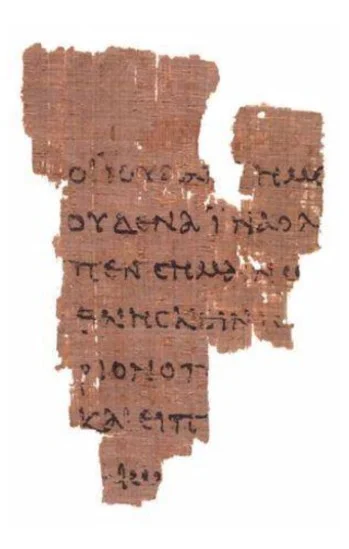
No other ancient book comes close. And the copies are early, too. There’s a scrap of John’s Gospel, small enough to hold in your palm, that most scholars date to the 100s, some nearer 200.
The oldest complete New Testament we have, a book called Codex Sinaiticus, is from around AD 350. And the early Christian writers quoted Scripture so often that most of the New Testament turns up in their quotations alone.
The honest part: the differences
Now the honest part, because I went looking for it. With that many hand copies, there are a lot of differences between them, hundreds of thousands of small ones. That sounds scary until you see what they actually are:
The name John is spelled with one n in some Greek copies and two in others. This is by far the most common kind of difference.
Greek can say “Jesus Christ” or “Christ Jesus”, “the Lord Jesus” or “Jesus the Lord”, and mean exactly the same thing.
A copyist skips a line, writes a word twice, or adds “the” before a name. The other copies show the mistake straight away.
The ending of the Lord’s Prayer (the prayer Jesus taught his followers) in Matthew’s Gospel, “For thine is the kingdom, the power and the glory”, isn’t in the earliest copies.
It most likely came from how the early Church prayed it.
The last twelve verses of Mark’s Gospel, and the woman caught in adultery in chapter 8 of John’s Gospel, aren’t in the earliest copies.
Good modern Bibles put them in brackets or a footnote.
In the old King James Version, an English Bible from 1611, a verse in the first letter of John (1 John 5:7) names the Father, the Word (a name for Jesus) and the Holy Spirit.
It isn’t in the early Greek copies.
But the Trinity, which is the Christian belief in one God in three persons, doesn’t hang on it: Jesus himself sends the apostles, his closest followers, to baptise “in the name of the Father, and of the Son, and of the Holy Spirit”.
Not one of these touches the core. That Jesus lived, died on a cross, rose from the dead and is God isn’t resting on one verse that might be shaky.
It’s in passage after passage, book after book, in every family of manuscripts. Delete every disputed verse and it would all still be there.
Even Bart Ehrman, an agnostic scholar who is famous for writing about these differences, puts it in his own words: essential Christian beliefs are not affected by textual variants. He does argue that a few of them change how a verse reads, so I’m not saying the text is spotless.
There’s one more honest thing to say. The oldest copies we have only take us back to about AD 200, with scraps a bit earlier.
For the first decades the story was passed on by the people who had been there, and the Gospels themselves were written down within living memory of it. Most scholars put them between about AD 65 and 100.
The years before the first copies
So what about those years in between, from the events to the first copies we hold? How do I know the story wasn’t changed then? A few things convinced me.
What kind of book it is
This is about the years before the first copies, what kind of books the Gospels are, and what archaeology has found.
Take the Temple. Jesus said the great Temple in Jerusalem, the centre of Jewish worship, would be torn down, not one stone left on another. In AD 70 the Romans did exactly that. They burned it to the ground, and it has never been rebuilt.
Now, if you were writing a (an account of Jesus’s life) after that, you’d be dying to add: and it happened, just like he said. None of the Gospel writers do. The Gospels and Acts (the history of the early Church) talk about the Temple as if it’s still standing.
Acts ends with , one of the first Christian leaders, still alive and under house arrest in Rome, around AD 62. Not a word about his death, or the death of his fellow leader , or the Temple falling.
For some scholars that’s a strong hint that Acts, and at least some of the Gospels, were written before AD 70, with the eyewitnesses still around. Most scholars put the Gospels a little later: Mark around 70, and the others between 70 and 100. Either way, they were written within living memory.
Why write it down at all? Most people back then couldn’t read. The faith spread by voice, with people who had seen it happen telling others. For thirty years, that was enough.
Then in AD 64 Rome burned, and the emperor Nero blamed the Christians. Peter and Paul were killed in the years that followed. The people who had seen it with their own eyes were dying, and if the story was going to survive, it had to be written down.
That’s when the writing picks up. An early , Papias, says that Mark, whose name is on one of the four Gospels, wrote down what Peter had preached.
What kind of book it is
And look at what kind of book it is. It isn’t a fairy tale with dragons and far-off kingdoms. The Gospels read like reporting: named governors, named high priests, named towns, named witnesses.
Luke, one of the four Gospel writers, opens his Gospel by saying he checked everything with the people who were there from the beginning.
That one got me personally. I do user research for a living, and Luke reads like a researcher: curious, careful about his sources, and maybe a bit of a skeptic himself. He wasn’t there, so he went and asked the people who were, and then wrote it down in order. I know that process. I do it every week.
The rest of the is mostly letters. Real letters to real churches, in Corinth, Rome, Ephesus and elsewhere, most of them from Paul, some from Peter, John, James and others, dealing with the real problems those churches had.
Take Paul’s first letter to the church in Corinth, a city in Greece, from the mid-50s. Christians there shared a meal of bread and wine to remember Jesus’s last supper with his friends. Most churches today call it .
But the rich were eating first and getting drunk, while the poor turned up to find nothing left. So Paul scolds them. Nobody scolds a church that doesn’t exist.
Matthew, Mark, Luke and John: four accounts of Jesus’s life, death and rising.
What the apostles, Jesus’s closest followers, did next, written by Luke. It ends with Paul in Rome, around AD 62.
Thirteen under Paul’s name, plus letters from Peter, John, James, Jude, and one to the Hebrews. Written to churches and people with names and addresses.
A vision given to John, written to seven real churches in what is now Turkey.
And the Old Testament
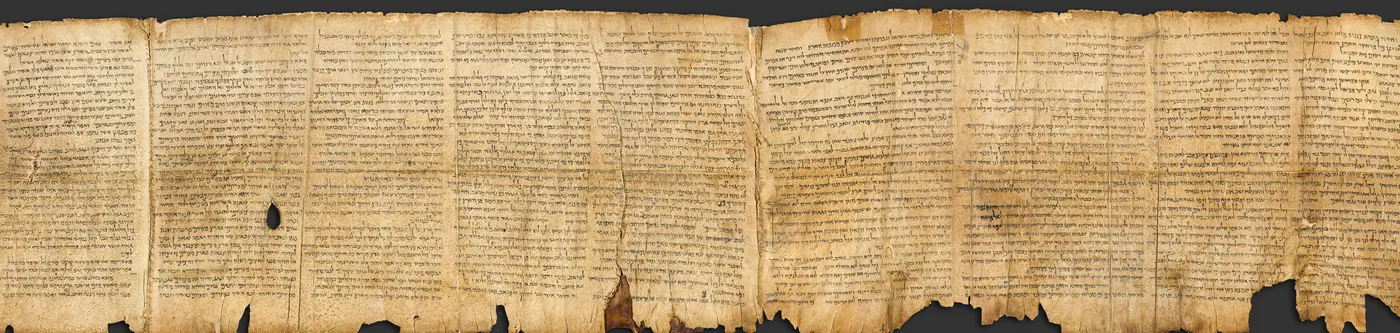
The , the Jewish Scriptures written before Jesus, held up the same way. Before 1947, our oldest Hebrew copy of the book of was from around AD 1000.
Then the turned up in caves by the Dead Sea, with a complete scroll of Isaiah about a thousand years older. Side by side, the two read almost exactly the same.
One thing to be clear about, because it’s easy to mix up. All of this shows that the message reached us the way it was written. It doesn’t show that the message is true. That’s a separate question, and it’s what comes next.
Does the ground back it up?
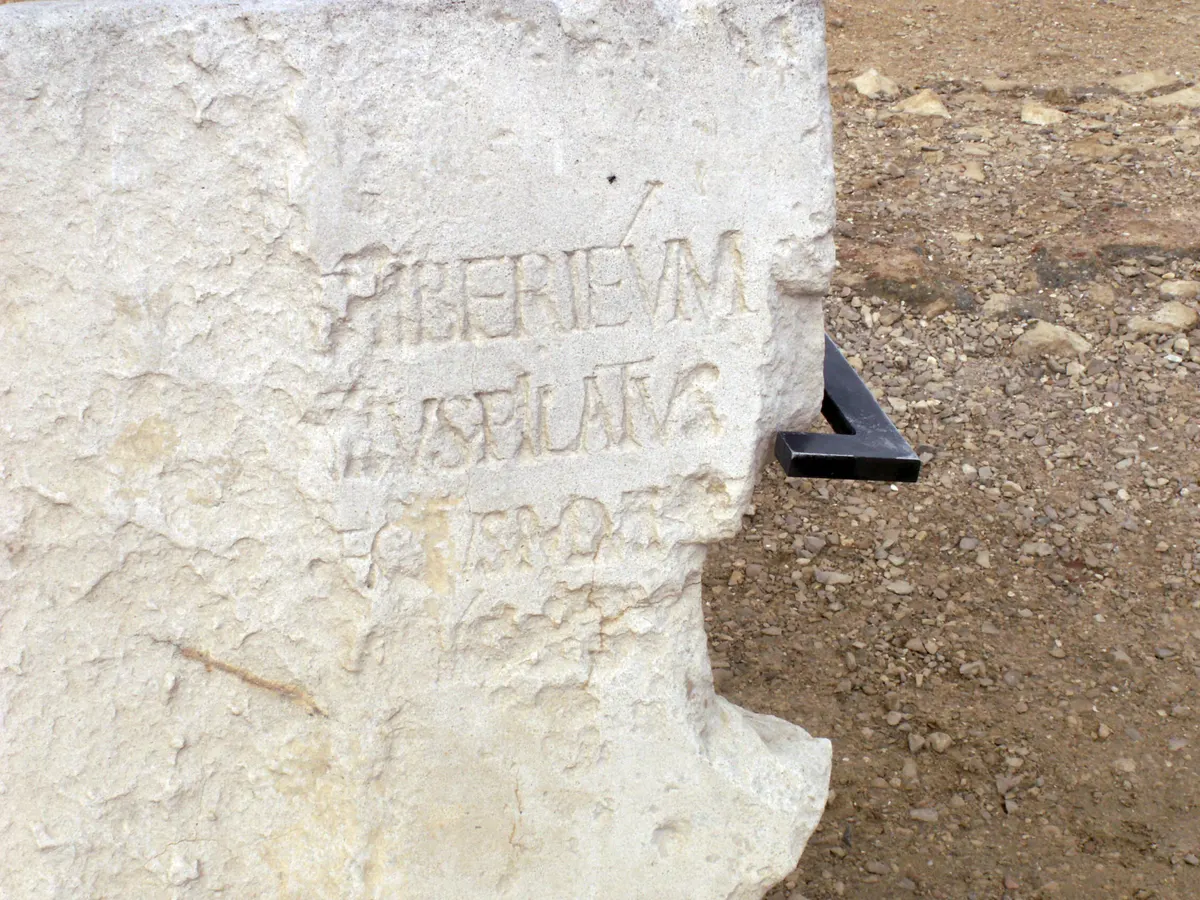
Then there’s archaeology. In 1961, at Caesarea on the coast of Israel, archaeologists found a stone with ’s name and title carved into it: prefect of Judea. Pilate was the Roman governor who ordered Jesus to be .
In 1990, in Jerusalem, a family bone box turned up inscribed “Joseph son of Caiaphas”, most likely the high priest who handed Jesus over to the Romans.
The Pool of Siloam, where John says Jesus healed a blind man, was dug up in 2004. The Pool of Bethesda, which John describes with its porches, was found too.
In 1968 a heel bone was found in a Jerusalem tomb with an iron nail still through it: a crucified man, given a proper burial in a tomb. So the Gospels’ account of Jesus being laid in a tomb after crucifixion isn’t far-fetched.
At Delphi in Greece, an inscription naming Gallio as governor lets us date Paul’s time in Corinth, the one Acts describes, to around AD 51.
Even small details check out. In Acts, Luke calls the city officials in Thessalonica, a city in Greece, “politarchs”, a title rarely found in ancient literature, and inscriptions from the city use exactly that word.
Archaeology can’t prove a miracle. But again and again, the people, places and small details the Gospels and Acts name turn out to be real. These aren’t stories set once upon a time.
Did he really rise?
This is what happened to Jesus’s closest followers after they said they saw him alive again, why none of them took back their story, and what the other explanations miss.
First, did Jesus really die? Some people say he just fainted on the cross and woke up later in the tomb.
But the Romans didn’t joke about . They were professionals at killing, it was their public warning to anyone who crossed Rome, and soldiers who let a prisoner get away could pay with their own lives.
When the soldiers came to break the legs of the crucified men to speed up their deaths, they found Jesus already dead. To make sure, one of them drove a spear into his side, and blood and water came out. , the Roman governor, even checked with the officer in charge that Jesus was dead before he let anyone take the body.
He was dead. So the next question is the real one: did he rise from the dead?
This is the one everything stands or falls on. , one of the first Christian leaders, says so himself: if has not been raised, our faith is useless. And in one of his letters he passes on a short creed (a statement of belief) that he says he had received:
that Christ died for our sins in accordance with the scriptures; that he was buried; that he was raised on the third day in accordance with the scriptures; that he appeared to Cephas, then to the Twelve. After that, he appeared to more than five hundred brothers at once, most of whom are still living…
Cephas is , by his name in Aramaic (the language Jesus spoke), and the Twelve are Jesus’s closest followers. Most scholars, including skeptical ones, date that creed to within a few years of the crucifixion. And naming living witnesses is basically saying: go and ask them.
Jesus’s tomb was first found empty by women. Back then a woman’s word counted for very little. , a Jewish historian of the time, records the rule for the courts: let not the testimony of women be admitted.
That was the prejudice of their world, not the truth about women. But think about what it means for the story. If you wanted people to believe it, you’d have Peter or John, two of the Twelve, find the tomb, men whose word everyone would accept.
So if you were making the story up, you wouldn’t pick the women. Even the , as the Twelve were called, didn’t believe the women at first. Luke’s says their report seemed to them like nonsense.
Why would they lie?
For me, the most important evidence of all is what happened to the apostles, because it’s human. You don’t need to read ancient Greek to weigh it.
You only need to know people, and people haven’t changed in two thousand years. So look at who these men were before they said they saw Jesus alive, and who they were after.
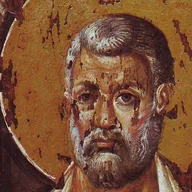
The night Jesus was arrested, Peter followed at a distance into the courtyard of the high priest’s house and stood warming himself by a fire.
A servant girl looked at him and said he had been with Jesus.
He swore he had never known the man, three times, and when the rooster crowed he went out and wept bitterly.
Then he hid with the others behind locked doors.
About fifty days later, at the Jewish feast of Pentecost, he stood up in the same city that had just crucified Jesus and told a crowd that God had raised him from the dead.
Arrested and brought before the same council that had condemned Jesus, Peter told them: we cannot stop speaking about what we have seen and heard.
He was flogged, and went on preaching. He died in Rome under the emperor Nero, around AD 64; early tradition says he was crucified, upside down.
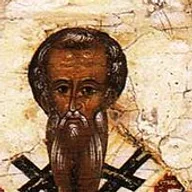
In the Bible’s world, “brother” covered close relatives, not only sons of the same mother.
The Catholic Church holds that Mary, Jesus’s mother, had no other children, so James was a kinsman, most likely a cousin; Orthodox tradition calls him a son of Joseph, Mary’s husband, from an earlier marriage.
Many Protestants believe he was a younger son of Mary and Joseph.
Whichever is right, he was family, and family didn’t believe.
Mark’s Gospel says Jesus’s relatives came to take him home because they thought he was out of his mind.
John’s Gospel says flatly that even Jesus’s brothers did not believe in him.
Paul names James among those the risen Jesus appeared to.
Within twenty years he was the leading figure of the church in Jerusalem, the one who spoke last at the council of the apostles.
Around AD 62, the high priest had James stoned to death.
Josephus, who was not a Christian, records it, and adds that fair-minded people in the city were so upset that they complained to the king, and the high priest lost his job.
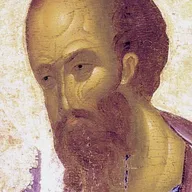
Paul, then called Saul, was a rising star in Judaism, trained under the great teacher Gamaliel, more serious about his faith than anyone his age, by his own account.
When Stephen, the first Christian martyr, was stoned, the killers laid their cloaks at Saul’s feet, and he approved.
He went house to house dragging Christians off to prison, then set out for Damascus, in Syria, with letters to arrest more.
On the road to Damascus, he says, the risen Jesus met him.
He spent the next thirty years walking and sailing thousands of kilometres across the Roman world, starting churches and writing the letters we still read.
Everything he had been proud of, he wrote, he now counted as rubbish next to knowing Christ.
He was whipped, beaten with rods, stoned and left for dead, shipwrecked three times, and jailed again and again.
He was executed in Rome in the 60s; tradition says he was beheaded, as a Roman citizen.
He wasn’t there the first time the others said they had seen Jesus alive, and he refused to take their word for it.
He said: unless I see the nail marks in his hands and put my finger into them, I will not believe.
A skeptic after my own heart.
A week later Jesus appeared again and told Thomas to touch the wounds.
Thomas answered, “My Lord and my God”, the most direct confession in the Gospels that Jesus is God.
Tradition says he carried the gospel, the good news about Jesus, as far as India and was killed near what is now Chennai.
The St Thomas Christians of Kerala, in the south of India, still trace their faith back to him.
Icons: Peter, Sinai, 6th century; James, Novgorod, 16th century; Paul, Andrei Rublev, about 1410; Thomas, Byzantine, Walters Art Museum. All public domain, via Wikimedia Commons.
Think like a detective
Now think like a detective. Why do people lie? For money, for power, for pleasure, or to save their own skin. The apostles got none of it.
What they got for their story was prison, beatings, exile and death. Paul lists being whipped five times, beaten with rods three times, stoned once and shipwrecked three times.
If it was a scam, it was the worst scam in history, because nobody who ran it got anything out of it.
Cover-ups crack
And cover-ups crack. In the 1970s, the men around an American president tried to cover up a break-in at the Watergate building.
They had money, power and the best lawyers in the country, and once prison was on the table, the story fell apart within about a year.
The apostles had no money and no power, faced far worse than prison, and as far as any source tells us, not one of them took it back to save himself.
To be honest about the evidence: the early sources only tell us how three of them died. We know James was stoned from Josephus, the Jewish historian. And a letter written by the church in Rome around AD 96 tells us Peter and Paul were killed for their faith. For the rest we only have later traditions.
Even a Roman who put Christians on trial, decades later, noticed the same thing.
Around AD 112, Pliny, a Roman governor, made accused Christians offer incense to the emperor’s statue and curse Christ, and added:
none of which those who are really Christians, it is said, can be forced to do
The other explanations
I couldn’t make it add up any other way. People will die for something false that they believe is true. Nobody dies for a lie they know they made up themselves.
Frightened people don’t turn brave overnight for a story they invented. Grief can make someone think they’ve seen a person they lost, but it doesn’t usually turn a skeptical relative and a persecutor into believers, or show five hundred people the same thing.
I looked at every other explanation I could find: that they hallucinated, that the body was stolen, that the story grew into a legend over time. For me, each one explained one piece and broke on the rest.
You can still see it today
And here’s what makes this evidence different from the rest: you can still see it today. In 2015, 21 men were marched onto a beach in Libya and killed for being Christians, and they are remembered for calling on the name of Jesus as they died.
All over the world, people still walk away from addictions, violence and old lives, and so many of them point to the same person.
I’m one of those changed lives myself. I went from lying on a rooftop, terrified of dying, to being able to look at death without it owning me.
What are the odds?
This is what the prophets wrote centuries before Jesus, and the chance of it all being luck.
There’s one more piece of evidence, and it’s the one that first made me stop and stare: the prophecies.
First, what is a prophecy? In the , it’s God speaking through a person, a prophet, often about something God was going to do in the future.
These prophecies were written down and copied for centuries before Jesus was born. Some of them are even in the , ancient scrolls found in caves by the Dead Sea, copied before his lifetime.
People who have counted the prophecies Christians see pointing to the , the rescuer God had promised, come up with anywhere from about 300 to over 450, depending on how you count them. Here are just a few:
Foretold: a ruler would come from the little town of Bethlehem. Fulfilled: Jesus is born in Bethlehem.
Foretold: a king from the family line of Jesse, the father of King David, Israel’s most famous king. Fulfilled: Jesus is born into David’s line.
Foretold: the king would come to Jerusalem humbly, riding on a donkey. Fulfilled: Jesus rides into Jerusalem on a donkey.
Foretold: thirty pieces of silver, thrown into the house of the Lord. Fulfilled: Judas, one of his own twelve, is paid thirty pieces of silver, then throws them down in the Temple.
Foretold: like a lamb led to slaughter, he would not open his mouth. Fulfilled: Jesus stays silent before his accusers.
Foretold: mocked with let the Lord rescue him, and lots cast for his clothes. Fulfilled: both happen at the foot of the cross. More on this one later.
Foretold: not one of his bones would be broken, just like the Passover lamb, eaten at the Jewish feast that remembers the escape from Egypt.
Fulfilled: the soldiers break the other men’s legs, but not his.
Foretold: he would be buried with the rich. Fulfilled: a wealthy man, Joseph of Arimathea, lays him in his own new tomb.
So what are the chances of one person fulfilling all of that by accident?
In 1958 a maths professor, Stoner, tried to put a number on just eight of these prophecies. His estimate for one man fulfilling all eight by chance was 1 in 10¹⁷: a 1 followed by 17 zeros. As a percentage, that’s 0.000000000000001%.
Stoner gave a picture for it. Cover the whole of Texas in silver coins, two feet deep. Mark one coin, mix them all up, and blindfold a man. He gets one try to pick the marked coin.
And those are the odds for just eight prophecies. Christians count hundreds.
To be fair, his numbers are estimates, and he treats each prophecy as if it had nothing to do with the others, which isn’t quite right.
Critics also point out that a few, like riding a donkey, someone could fulfil on purpose, and that our record of the fulfilments is the themselves, the four accounts of Jesus’s life, written by people who knew these texts.
Jewish readers understand many of these passages differently too.
But most of them were completely out of Jesus’s hands: where he was born, which family he was born into, how he died, and what the soldiers did with his clothes. You can’t arrange those.
So don’t treat it as a number you can trust completely. I include it because of what it did to me. I couldn’t call that luck.
On the site: Jesus of Nazareth · Where the Bible came from · The martyrs
Does the good cancel out the bad?
If you steal from a friend and then do good somewhere else, are you even? And what does Christianity call the wrong?
So now I knew the text of the hadn’t been changed along the way, the case for the (Jesus rising from the dead) was far stronger than I had ever been told, and the prophecies (written centuries before him) looked nothing like luck.
Okay, cool. But so what?
A reliable book is still just a book, and a historical fact doesn’t save anyone by itself. So I kept digging, and the question under all of it was: be honest, based on all the evidence, is Jesus God?
Here’s what I didn’t expect.
The harder I hit Christianity, the more in awe I became.
Does the good cancel out the bad?
The first thing that got me was how honest Christianity is about us. But let me start with what most people around us believe, because you’ll hear some version of it everywhere.
Be a good person. Do more good than bad. Nobody’s perfect, but as long as the good outweighs the bad, you’re fine. On paper, that sounds completely fair.
Most of the beliefs I looked at said some version of it. Karma: it all balances out in the end. Or the secular version: there’s no real right and wrong anyway, we’re just animals, and it’s survival of the fittest. Right and wrong are whatever your society decides. Your truth is yours and my truth is mine.
But think about it for a second. Does the good really cancel out the bad? Say you steal $10,000 from a friend, and then you give $10,000 to charity. Have you fixed anything?
No. Look at it from your friend’s side. They’re still $10,000 down. Doing good somewhere else doesn’t fix what you did to them.
And before you say just give the money back: even if you return every last cent, the damage is already done. They trusted you, and you broke that.
The shock, the worry, the nights your friend couldn’t sleep, the hurt of being betrayed by someone they trusted: all of that has already happened. And no refund can undo that.
So a wrong isn’t just a number on a scale that good deeds can balance out. It breaks something real. And deep down, everybody knows that.
This is what got me. Christianity doesn’t sugar-coat any of this. It calls the wrong what it is.
The Bible has a word for that kind of wrong: . And it says the wages of sin is death.
In plain words: what sin earns, in the end, is death. That’s why you and I, and everyone we’ve ever loved, are on the same road to the same end.
Why death, of all things? Because God is where life comes from. Walk away from the source of life, and what’s left, in the end, is death.
Where it all went wrong
This is what the garden was meant to be, what broke, and why God didn’t just forgive and move on.
So how did we all end up on that road, the one that ends in death? It goes back to the very beginning, to in the garden.
The story, in a few lines
If you don’t know the story, here it is in a few lines. The says God made the first two people, Adam and Eve, and put them in a garden where they had everything they needed. They could eat from any tree there, except one. God told them: don’t eat from that one, or you will die.
Then a serpent came along and told them God was lying. Eat it, it said, and you’ll be like God, deciding good and evil for yourselves. So they ate. And everything changed.
People hear that story and laugh: all this over a piece of fruit? But whether you read it literally or not, the point was never the fruit. The point is trust.
A parent and a child
Think of a parent and a small child. The parent says: trust me on this, okay? If you bang your head on the wall, you’re going to hurt yourself.
Then someone else walks in and whispers to the kid: nah, your parents are just messing with you. It doesn’t hurt. They just don’t want you to have fun. So the kid tries it, and gets hurt.
What the garden was meant to be
To see why that matters, you have to see what the garden was meant to be. God made everything good. People close to him and close to each other, living in harmony with the animals and with the whole of creation.
There was no anxiety, no loneliness, no fear of dying. Creation was never meant to feel any of that.
That’s what was at stake when God said trust me. In other words: I am the source of everything good, so stay close to me.
Then another voice, which the Bible pictures as a serpent, said: he’s lying to you, and you can decide for yourself what’s good and what’s bad. Adam and Eve chose to go their own way instead of trusting him.
They grabbed an independence that was never theirs to take, and they got hurt, just like God said they would.
What broke
When Adam and Eve walked away from God, the source of good, the harmony broke. Every one of their relationships cracked at once:
Anxiety, loneliness, the fear of death: the very things I was drowning in after that day on the rooftop, when I thought I was dying, were never part of the design.
And it didn’t stop with them
And the break didn’t stop with Adam and Eve. The Church’s name for it is original sin, but the idea is simple. They didn’t just break a rule. They broke a relationship.
We were made to live close to God, and that closeness was lost, not just for them but for everyone after them.
Every one of us is born with a habit: putting ourselves first, and doing things our own way, even when we know better. Nobody has to teach a toddler to grab a toy and shout mine, or to lie about who broke the vase.
You see it on the news every day: wars, greed, people using each other. And if I’m honest, I could see it in myself too. I had trusted myself over God my whole life.
Why didn’t God just forgive them?
You might be wondering: why didn’t God just forgive Adam and Eve and move on?
He can, and he does. Forgiving is his to give. But forgiving isn’t the same as fixing. Picture this.
A dad loves his son, and has always been good to him. But the son wants to live his own way. One day he walks out, and cuts his dad off completely.
His dad did nothing to deserve it. It breaks his heart, and for years he lives with that hurt.
His dad keeps calling, but the son won’t pick up the phone. He’s busy partying instead, drinking night after night with his friends, and slowly it wrecks his liver. One day he ends up in hospital, and the doctors say he’s dying.
His dad hears, and comes straight away. The son can barely look at him, but he whispers I’m sorry. Right there at the bed, he forgives him for every hurtful word and every missed call. He forgives him completely.
But forgiving him doesn’t fix his liver. The son is still dying. No magic wand, bibbidi-bobbidi-boo, makes that go away.
So the dad does the one thing that can save him. He gives his son part of his own liver.
Nobody forced the dad to give part of his liver. He chose to. And notice what he didn’t do. He didn’t make his son suffer first, or wait to be paid back for all those years, before he’d forgive him. The forgiveness was free.
But saving him cost the dad something real. A big operation, weeks of pain while he recovered, and a small but real chance he wouldn’t survive it himself.
That’s our situation. Sin isn’t a fine we owe. It’s the son’s liver: we walked away from the source of life, and it’s killing us. God forgives freely. And to heal us, he chose to do what the dad did: give himself. Hold on to that.
Is that fair on us?
Now, back to the habit we’re all born with: putting ourselves first, and doing things our own way, even when we know better. That’s what the Church calls .
Is it unfair, being born with something that wasn’t even our doing? The Church is clear that it isn’t a personal fault you committed.
It’s a wound we inherited, a bit like a child born into a broken family: they didn’t cause the break, but they grow up living with it.
And it would be unfair if God had left us alone with it. But he didn’t. That habit of putting ourselves first is real, but it doesn’t control us.
We can still choose. And God has never stopped showing us the way back.
Think of a lighthouse on a dark coast. It doesn’t grab the wheel and steer your boat for you. But it shows you where the rocks are, and where the harbour is.
You still choose where to steer, but you’re never sailing blind. That’s how God has guided people all through history.
But a light on the coast doesn’t fix what broke. The relationship was still broken, and the wrong still had to be put right. So did God just leave it there? No. The rest of the Bible is his rescue plan.
The rescue plan
This is the first promise, the long rescue one step at a time, and why people kept falling back.
Back to , the first two people in the ’s story. They had stopped trusting God and gone their own way.
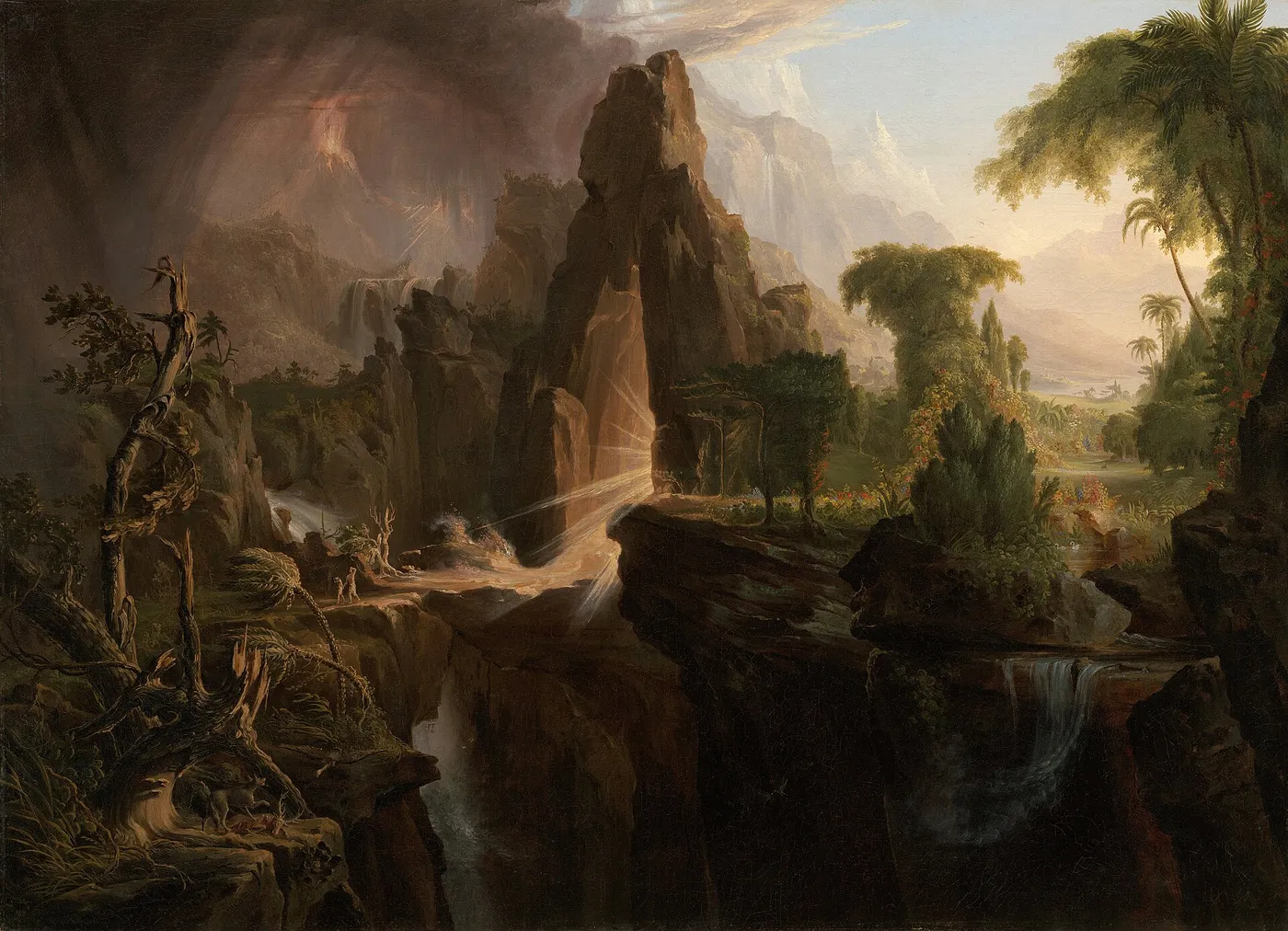
The Bible describes them leaving the garden. That wasn’t God being cruel. It was the consequence of their own choice. You can’t walk away from the source of life and still keep living in it.
And God won’t force anyone to stay close to him, because love that’s forced isn’t love.
So they stepped out of the closeness they were made for, into a harder world where pain, hard work and, in the end, death were waiting.
The first promise
But that isn’t where the story ends. Right there in the same story, God’s very first move was a promise: one day, someone from the human family would come and put right what had gone wrong.
The rescue started the same moment things went wrong.
One step at a time
And then God worked with us, slowly. He wasn’t holding anything back. We just weren’t ready to take it all in at once.
Think of how you’d teach a small child. You don’t start with everything. You start with what they can handle, you stay patient when they get it wrong, and you never give up on them.
That’s how God worked with people: one step at a time, one promise at a time. The Bible’s word for these promises is covenant. Think of it less like a contract and more like a marriage vow.
God binds himself to his people. He says: I will be your God, and you will be my people. And he asks them to trust him and live his way.
That’s what the whole , the part of the Bible written before Jesus, is about. God starts small, makes promises to ordinary people, flaws and all, and keeps every one. And watch what happens to the promise as the story goes on.
The promise keeps narrowing, from the whole world down to one family, one nation, one royal line, and finally one person who is still to come:
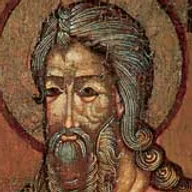 NoahThe whole earth
By Noah’s time, many generations after Adam and Eve, the world had become so violent and so evil that it was destroying itself.
The Bible says it grieved God to his heart. Not the anger of someone whose rules were broken, but the grief of a parent watching their children tear each other apart.
The flood was judgement on that evil. But even then, God didn’t give up on us. He kept Noah and his family, the few who still trusted him, so that the human story, and the rescue he had promised, could carry on.
Afterwards he promised never to wipe out life like that again. From then on, he would work with us as we are, mess and all.
The sign was the rainbow. In the ancient world a bow was a weapon, and many read it as God hanging his up in the sky.
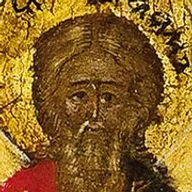 AbrahamOne family
Next, God started with one man who trusted him.
Abraham was seventy-five when God told him to leave his home and his relatives for a land he had never seen. He had no map and no guarantees. He went anyway.
God promised him a family as countless as the stars, and that through his family the whole world would be blessed. The catch: Abraham and his wife Sarah had no children, and they were old.
They waited twenty-five years, and they doubted. At one point they tried to make it happen their own way: Sarah gave Abraham her servant Hagar, and Hagar bore him a son, Ishmael.
God cared for Hagar and Ishmael too, and promised that Ishmael would become a great nation. But the promise to Abraham was to come through Sarah, and it did. When Abraham was a hundred, Sarah gave birth to their son Isaac.
That’s the pattern God was building: a promise that looks impossible, and a God who keeps it anyway.
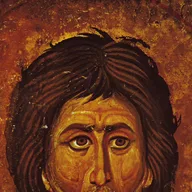 MosesOne people
Abraham’s grandson Jacob had twelve sons. One of them, Joseph, was sold by his own brothers, ended up in Egypt, and rose to become one of the most powerful men in the country.
When a terrible famine hit, Joseph brought his whole family to Egypt to survive. They settled there and grew, generation after generation, into a whole people.
Then a new Pharaoh, Egypt’s king, came to power who didn’t remember Joseph. He was afraid of how many of them there were, so he forced them into slavery.
God heard them. Through Moses, the man he chose to lead them, he brought them out, and showed them, and everyone watching, that he is the God who sets people free.
Then, in the desert, he gave them the Ten Commandments. Not rules to spoil their fun, but how to live close to him and to each other, like a good parent’s house rules.
He even told them to build him a tent to live in, right in the middle of their camp. God wanted to be close to them. The whole thing was about relationship.
Even so, they grumbled and doubted the whole way, and spent forty years in the desert before they reached the land he had promised.
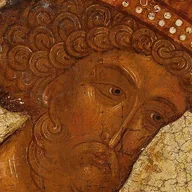 DavidOne king’s family
Later the people asked for a king like the other nations had. God chose David, the youngest son of a shepherd family, the boy who took on the giant Goliath.
David was far from perfect. At the height of his power he slept with another man’s wife and had her husband killed to cover it up.
But when he was confronted, he didn’t make excuses. He owned it, and he came back to God. That is why the Bible calls him a man after God’s own heart: not because he never fell, but because he kept coming home.
God promised David that one of his descendants would be a king whose kingdom would never end.
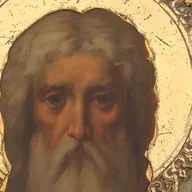 The prophetsOne person, still to come
The kings after David mostly drifted, and the people with them. Every time, God sent prophets, messengers who spoke for him, to call them back. Many of those prophets were ignored, and some were killed for it.
In the end the people lost almost everything. Jerusalem, their capital, was destroyed, and they were taken into exile in Babylon, in what is now Iraq.
But even then, the prophets kept pointing forward. A servant “pierced for our sins”, who would heal us by his wounds. A new heart for people with hearts of stone. A new covenant, written not on stone but on people’s hearts. God himself coming to look for his lost sheep. A ruler born in the little town of Bethlehem.
Icons: Noah, 17th century; Abraham, from a Russian icon of the three patriarchs, 18th century; Moses, Sinai, 13th century; David, Novgorod school; Isaiah, 19th century. All public domain, via Wikimedia Commons.
The same thing, again and again
And all through those centuries, you watch the same thing happen, again and again, on almost every page:
- 1They trust God, and life goes well.
- 2They get comfortable, and forget him.
- 3They go their own way: treating each other badly, chasing other gods.
- 4Things fall apart.
- 5They cry out to God, and he brings them back.
When the people trusted God, things went well. When things fell apart, they came running back to him. And when life got good again, they got comfortable. They forgot him, started treating each other badly, and went after other gods.
Not because God needed their worship. It’s the garden all over again. He knows what’s best for us, and every time we decide we know better, we bang our heads on the wall.
And they did it even though they knew their own history. They had heard what happened to their parents and grandparents. Honestly, it isn’t that different from us.
And every single time, God reached out again. If you read the Old Testament as one story, that’s what it’s about: a God who refuses to give up on people who keep giving up on him.
Why a sacrifice?
This is why the Old Testament is full of lambs, what they could do, and what they never could.
All the way through the ’s story, there was one more thread. It’s the strangest one, and it’s the one that finally made the cross make sense to me.
All through the , people offer lambs as sacrifices. It sounds strange today, maybe even cruel. Does God enjoy watching a lamb die? No. So why?
Remember the son in the hospital? His drinking didn’t earn him a fine. It was killing him. Walking away from the source of life works the same way: what it costs is… life itself. That’s why the Bible says earns death.
We find that hard to hear, because deep down we assume we’re basically innocent, and that our wrongs are small. But that’s exactly the point. What we do really does lead to death.
But be clear on one thing. Death isn’t a fine God decided to charge. It’s what sin actually is. Sin cuts us off from the source of life, and cut off from life, all that’s left is death.
God didn’t invent that, any more than a parent invents the wall that hurts a child who was told not to bang his head on it.
The sacrifices were how people atoned for their sins, which means setting things right with God. A life was given, the innocent standing in for the guilty. It showed, in a way nobody could miss, what sin really costs.
That’s not God being petty. That’s how serious sin is. Blood was shed. And it is hard to watch, because sin is not small.
And notice what kind of lamb it had to be: one without a single flaw. A life without fault, given for lives that are full of it.
Follow the lamb
Follow the lamb through the Bible and you can watch the lesson build:
Right after Adam and Eve, the first two people, went their own way, the Bible says God himself made them clothes out of animal skins.
Even then, he was looking after them, covering their shame. But something had to die to do it.
Abraham was surrounded by peoples who offered their own children to their gods. It was normal all around him.
Into that world, God asked Abraham for his son Isaac. Not because he wanted the boy, but to teach Abraham, and everyone after him, something they would never forget.
Abraham trusted him and went. On the way up the mountain Isaac asked, where is the lamb? Abraham answered, God himself will provide the lamb.
At the last moment, God stopped him. A ram caught in a bush was offered in Isaac’s place.
The lesson was the opposite of everything around them: the God of Abraham doesn’t take children. He provides the sacrifice himself. Centuries later, he would do exactly that, with his own Son.
Long after Abraham, his descendants were slaves in Egypt.
God had warned Pharaoh, Egypt’s king, again and again to let his people go, and Pharaoh kept refusing.
On the last night, death came for the firstborn of every family in Egypt.
To be spared, each family killed a young lamb without a single flaw and painted its blood on their doorframe. Death passed over every house that was marked.
Jewish families still remember that night every year, at the feast of Passover.
The lamb died, and the family lived.
Once a year, on the Day of Atonement, the most important day of the Jewish year, the high priest took two goats.
The first was sacrificed: the price of the people’s sins, paid.
Over the second, he laid his hands on its head and confessed every sin the people had committed that year. Then it was sent off into the desert, never to come back.
Think of a debt that has been paid, and then the paper it was written on is torn up and thrown away. Paid, and gone. That’s where our word scapegoat comes from.
The Temple in Jerusalem was the one place these sacrifices were offered. There, a lamb was offered in the morning and another in the evening, every day, year after year: a daily reminder that the problem was still there.
It never stopped, because it never actually finished the job.
Then the prophet Isaiah, one of the messengers God sent to his people, wrote about a person, not an animal: someone like a lamb led to slaughter.
And the Lord laid upon him the guilt of us all.
What the lamb could and couldn’t do
Do you see it building? Sin costs a life, and God himself provides the one who pays it.
And those sacrifices really did work, for a time. God accepted them, and the people were forgiven.
But notice who provided the lamb. God did. People were never meant to sacrifice each other. Remember : the peoples around him burned their own children for their gods, and God stopped his hand and provided the sacrifice himself.
Later, through the prophet , about 600 years before Jesus, God said child sacrifice was something I did not command, nor did it come into my mind. He never wanted a human life from us.
And the animal sacrifices were never meant to be permanent either.
An animal couldn’t reason or make a moral choice the way we can, so giving its life was never truly its choice. It could cover the people for a while, and then the next sin needed the next lamb, year after year.
And no ordinary person could take the lamb’s place for good. Every one of us has our own sin to answer for, and no one has the right to take another person’s life to pay for theirs.
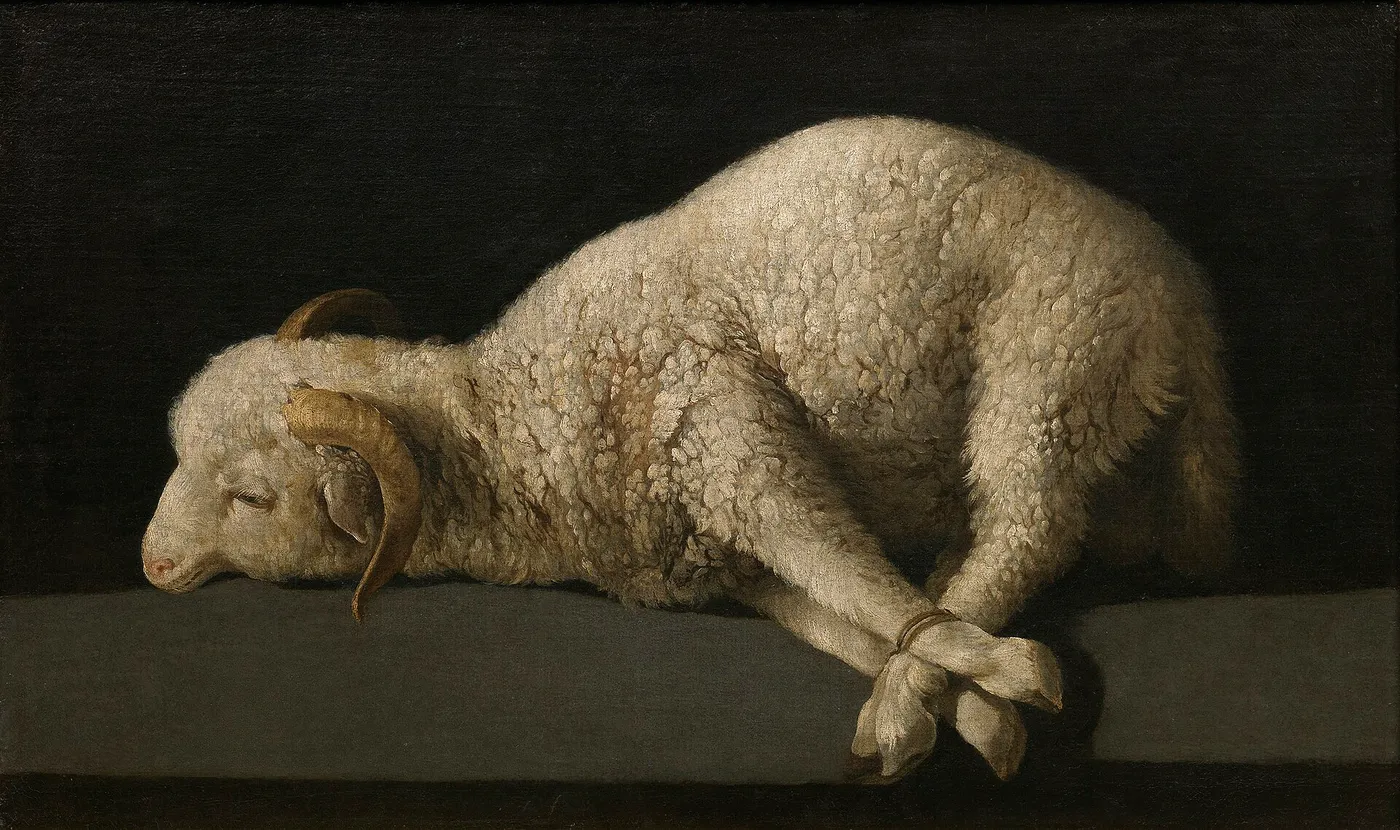
It was always meant to be a foreshadowing: a signpost pointing at someone still to come. A person without any sin of his own, who would choose to give himself, once, for everyone.
So by the end of the Old Testament, everything is pointing forward. God had promised a child, and a king from King David’s family whose kingdom would never end.
And there was a servant who would suffer for other people’s wrongs, and a lamb that would finally be enough. Every promise, every hint, every signpost points at the same person.
God comes himself
This is who Jesus spent his time with, what he taught, and why his mercy was never just letting things slide.
We had walked away from God, and we couldn’t fix that from our side.
So God did what had been his plan all along. To save his own creation, he stepped into our broken world himself.
He was born as a baby in Bethlehem, into the family of and David, just as promised. Every promise lands on him.
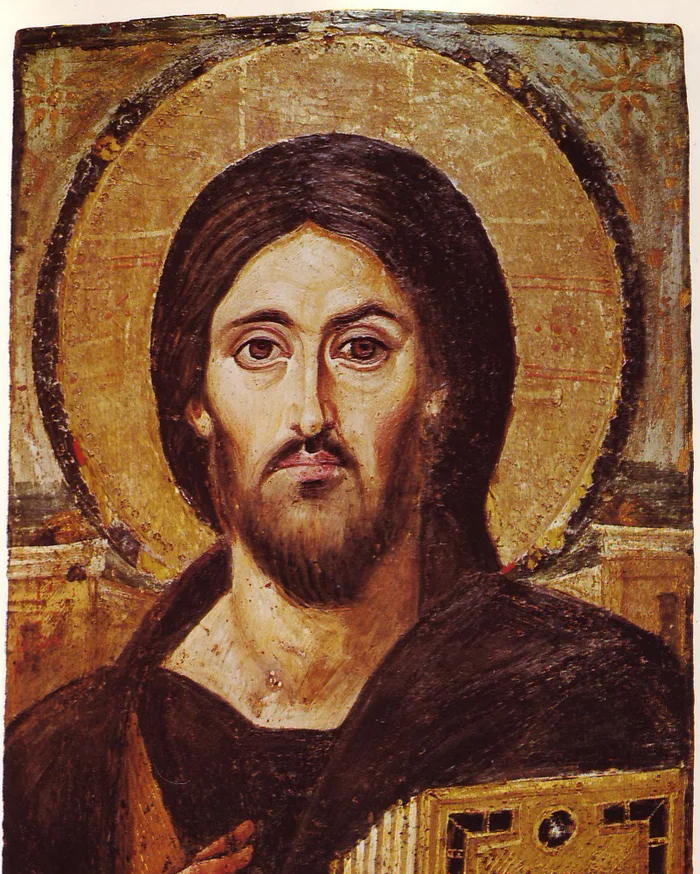
Why would God go that far? Because he loves us. Hold on to that, because it’s where this whole story ends for me.
When Jesus was about thirty, he started his public life. The first time , a prophet sent to get people ready for him, saw him coming, he said: Look, the Lamb of God, who takes away the sin of the world.
For centuries, God’s people had offered lambs as sacrifices for their wrongs. So you can see why that line would have stopped people in their tracks.
Then look at how he lived. I had heard these stories as a kid and they washed over me. Reading them as an adult, fresh off that rooftop, they hit completely differently.
The people everyone else avoided
Start with who he spent his time with. In his day, tax collectors were Jews who collected money for the Roman occupiers, and most skimmed extra for themselves. To everyone around them they were traitors and thieves, and honestly, many were. No respectable person would be seen at the same table.
Jesus walked up to one of them, Matthew, sitting at his tax booth, and said follow me. Matthew got up and left the booth.
Then Jesus went to his house for dinner, with a whole crowd of tax collectors and sinners. Sharing a meal back then meant accepting someone. The religious leaders were appalled.
When they complained, Jesus answered: it isn’t the healthy who need a doctor, but the sick. I have not come to call the righteous, but sinners to repentance.
That’s the part people miss. He didn’t go to them to say what they did was fine. He went to call them back, and they changed.
Another tax collector, Zacchaeus, had cheated people for years. After one meal with Jesus he stood up and said he would give half of what he owned to the poor, and pay back four times what he had taken.
Then there were the lepers. Leprosy ate the body slowly, and the Jewish law said anyone with it had to live outside the town, keep their distance, and shout unclean! if anyone came near. Some of them hadn’t been touched by another human being in years.
A leper came to Jesus and said, if you want to, you can make me clean. And before he healed him, before anything else, Jesus reached out and touched him. Then he said, I do want to.
And then there was the woman. At a dinner in the house of a religious leader, a woman the whole town knew as a sinner, most likely a prostitute, came in uninvited.
She knelt at his feet, cried on them, wiped them with her hair, and kissed them. The host was disgusted that Jesus let her near him.
Jesus turned to the host and said: you gave me no water for my feet, no kiss, no oil. She hasn’t stopped. Her many are forgiven, because she has loved much. And to her: your sins are forgiven. Go in peace.
A love that turns the world upside down
Then there’s what he taught. The world says blessed are the rich, the strong, the winners. Jesus stood on a hillside and said the opposite: blessed are the poor in spirit. Blessed are those who mourn. Blessed are the merciful.
He was speaking in a country occupied by Rome, to people who had every reason to hate. And he said: love your enemies. Pray for the people who persecute you. If someone slaps you on one cheek, turn the other.
, one of his twelve closest friends, once asked him how many times he had to forgive someone, and offered seven, which was already generous. Jesus said: seventy times seven. In other words, stop counting.
Stories you could carry home
And he taught in stories ordinary people could carry home with them. A son who demands his inheritance early, basically telling his father I wish you were dead, wastes it all, and crawls home hoping to be taken on as a servant.
Everyone listening would have expected the father to let him have it: a lecture, some conditions, a probation period at least.
Instead, the father sees him from far off and runs down the road to him. Old men didn’t run in that culture. It was undignified. He didn’t care.
The son starts the speech he’s been rehearsing, and the father cuts him off and calls for a feast. Having his son back was enough.
In another story, a man is beaten and left for dead on the road. A priest walks past. A temple official walks past. The one who stops, bandages him, and pays for his care is a Samaritan, from a people the listeners despised. Jesus made the hated outsider the hero of the story.
He healed, and he forgave
He healed the blind, the deaf, the sick, the ones everyone had written off. But watch what he did with a paralysed man whose friends lowered him through a roof to reach him. The first thing Jesus said wasn’t get up. It was your sins are forgiven.
The religious leaders were furious: only God can forgive sins. So Jesus said, which is easier to say? And then, so that you know I have that authority: get up, take your mat, and go home. And the man got up and walked.
And on the night before he died, he got down on his knees and washed his friends’ dirty feet. A king who came to serve, not to be served. The humble king, the servant of all.
He didn’t just tell us how to live. He showed us what loving people actually looks like. When people today say treat others the way you want to be treated, this is where that comes from, and this is what it looks like done properly.
Isn’t that just enabling?
I can hear the objection, because I had it. Forgive everyone, love your enemies, welcome the sinner back: isn’t that just letting people get away with it? Today we’d call it enabling.
Look closer at what he actually did. When a woman caught in adultery was dragged in front of him, he sent her accusers away one by one. Then he turned to her and said: go, and from now on, don’t sin any more. She was forgiven, yes. But she was never told it was fine.
And he was blunt. He called the religious leaders whitewashed tombs, clean on the outside and rotten inside, and a nest of snakes, to their faces. He flipped over the tables of the people turning the Temple, the centre of Jewish worship in Jerusalem, into a market.
He told a rich young man exactly what was standing between him and God. The man had kept God’s commandments since he was a boy, and asked what else he needed to do. Jesus looked at him, loved him, and said: go, sell what you have, and give to the poor … then come, follow me.
The man walked away sad, because he had a lot of money to give up. And Jesus let him go. He wasn’t soft.
Think of the best parent you know. When their kid messes up, they don’t pretend it didn’t happen, and they don’t throw the kid out either. They deal with it honestly, and the kid stays loved the whole time.
Or a good doctor: kind, and still tells you the diagnosis straight. Mercy isn’t a free pass. It’s what makes change possible.
That’s the difference. Enabling says it doesn’t matter. Jesus says it matters so much that I’ll pay for it myself, and now you can leave it behind. He met people exactly where they were. He never left them there.
Checkmate
This is the cross hour by hour, why his life was enough, and what happened on the third day.
After about three years of teaching and healing, it was , the Jewish feast that remembers how God freed his people from slavery in Egypt. It was the very feast of the lamb. And Jesus didn’t just stroll to the cross. Here is what his last day looked like:
- Thursday nightThe last supper
He shared a final meal with his closest friends, at Passover time. He took bread and said, this is my body, given for you.
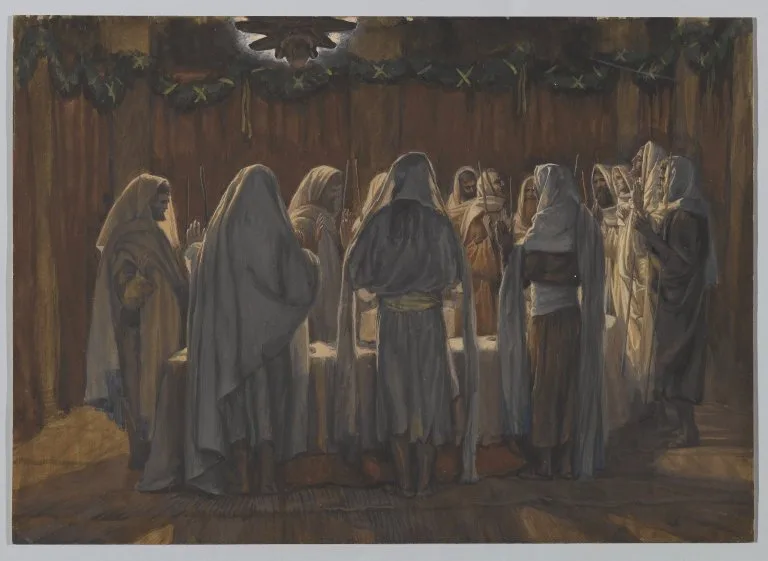
The Last Supper, by James Tissot, 1886–94. Tissot spent years in the Holy Land painting the Gospels as they might really have looked. James Tissot, Public domain - Later that nightGethsemane
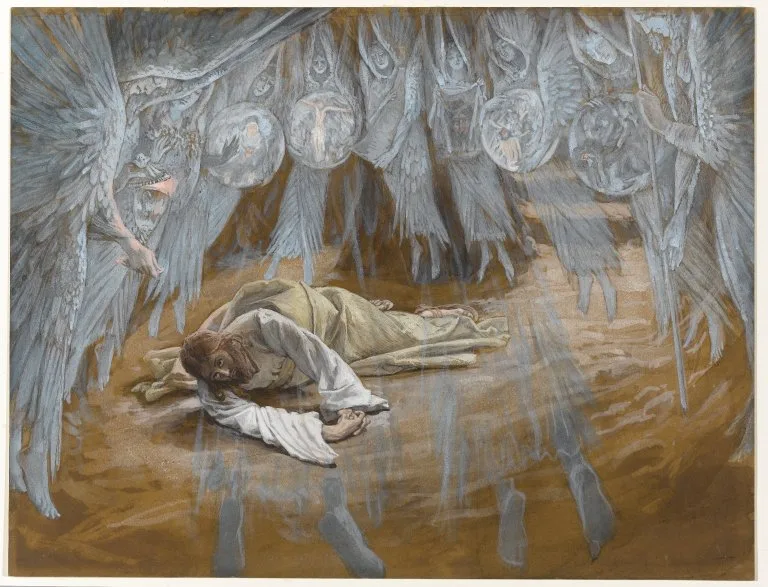
He prayed in a garden, knowing exactly what was coming. He was in such anguish that his sweat fell like drops of blood. Not my will, but yours.
The Grotto of the Agony, by James Tissot, 1886–94: Gethsemane, the night before. James Tissot, Public domain - Around midnightBetrayed
Judas, one of his twelve closest friends, led armed men to him and pointed him out with a kiss, for thirty pieces of silver.
The rest of his friends ran. Even Peter, the friend who had promised never to leave him, swore he had never known him.
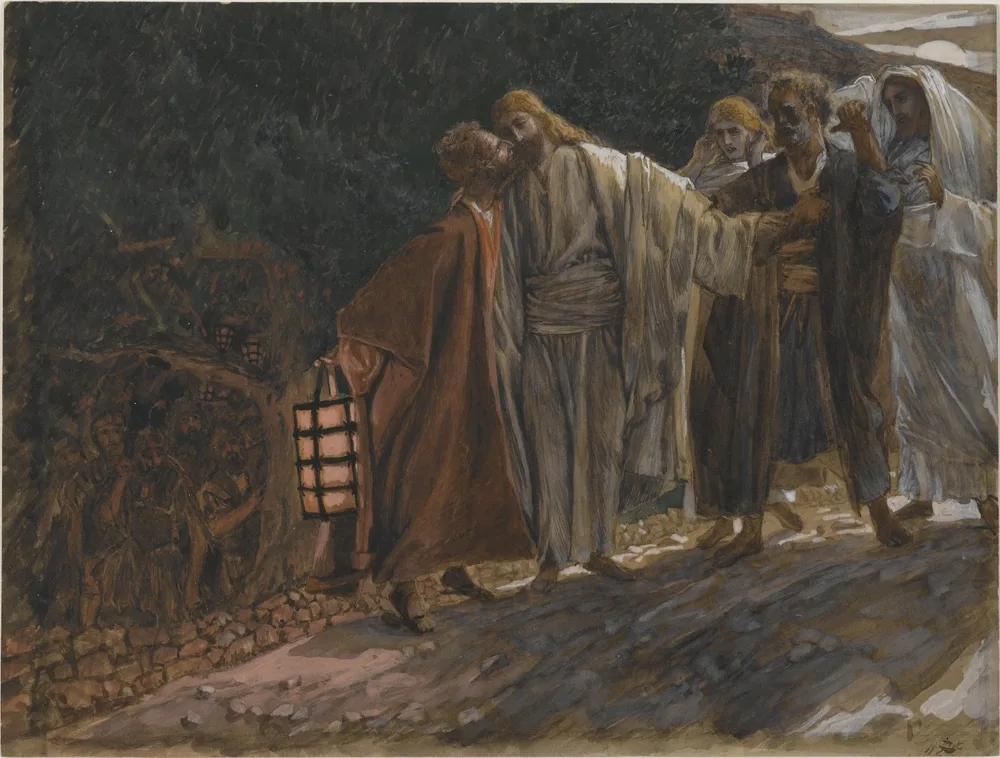
The Kiss of Judas, by James Tissot, 1886–94. James Tissot, Public domain - Through the nightBeaten
He was dragged before the religious leaders. They blindfolded him, spat in his face and hit him, laughing: prophesy, who hit you?
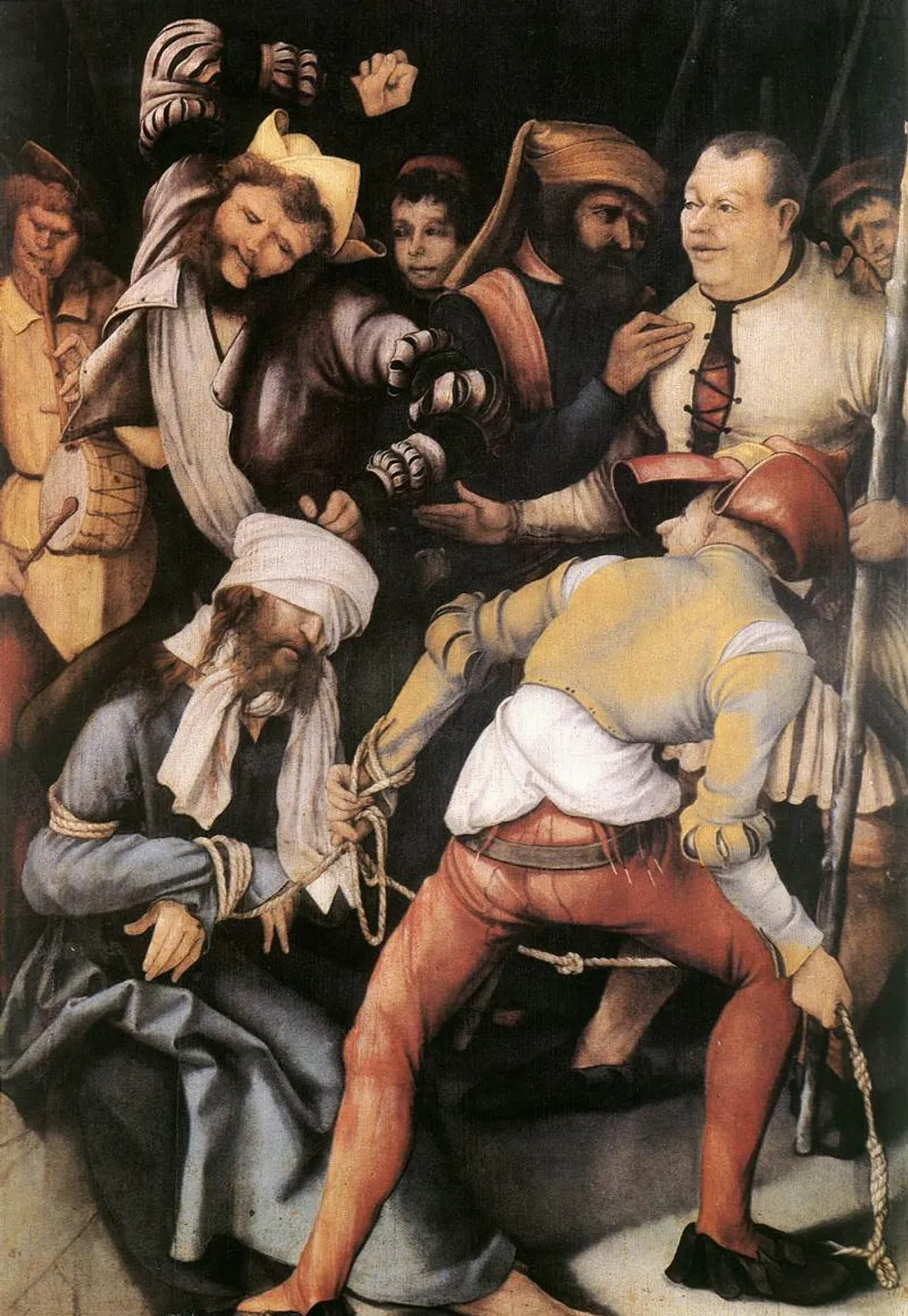
The Mocking of Christ, by Matthias Grünewald, around 1504. Matthias Grünewald, Public domain - Early morningPilate
The Roman governor, Pontius Pilate, found nothing to charge him with. But the crowd shouted crucify him!, and Pilate gave in.
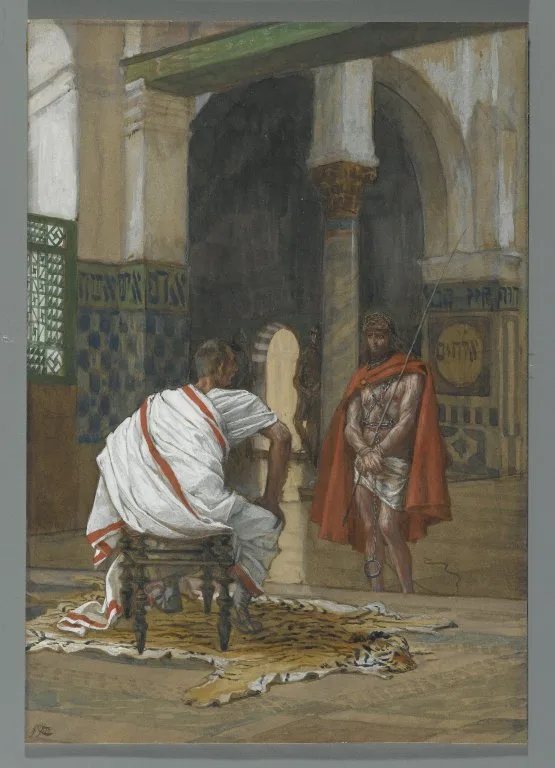
Jesus Before Pilate, Second Interview, by James Tissot, 1886–94. James Tissot, Public domain - MorningThe flogging
Roman soldiers whipped him. Their whips had pieces of bone and metal tied into the leather, made to tear the skin.
Men sometimes died from the flogging alone.
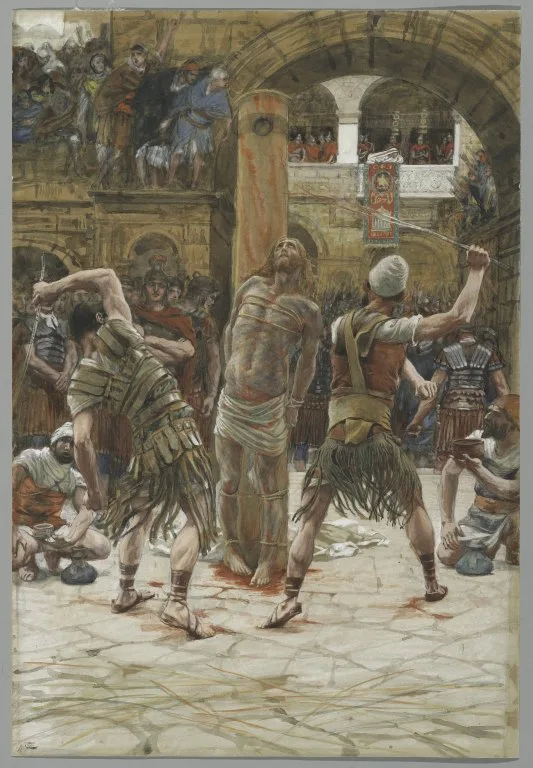
The Scourging on the Front, by James Tissot, 1886–94. Tissot painted the Roman whip as it was, with bone and metal tied into the thongs. James Tissot, Public domain - MorningThe crown of thorns
The soldiers twisted thorns into a crown and pushed it onto his head. They threw a purple robe over him, knelt in front of him to mock him, hail, king of the Jews, and beat him over the head.
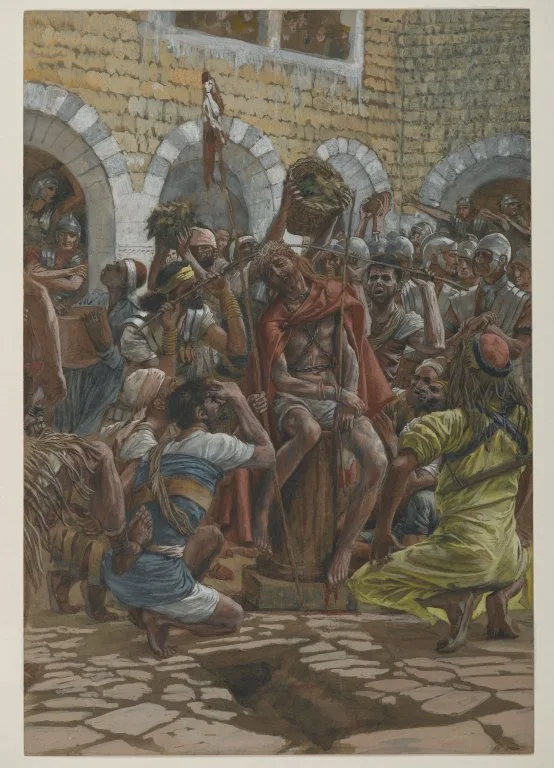
The Crowning of Thorns, by James Tissot, 1886–94. James Tissot, Public domain - Mid-morningThe road
Beaten and bleeding, he had to carry the beam of his own cross through the streets.
He was so weak that the soldiers forced a passer-by, Simon, to carry it for him.
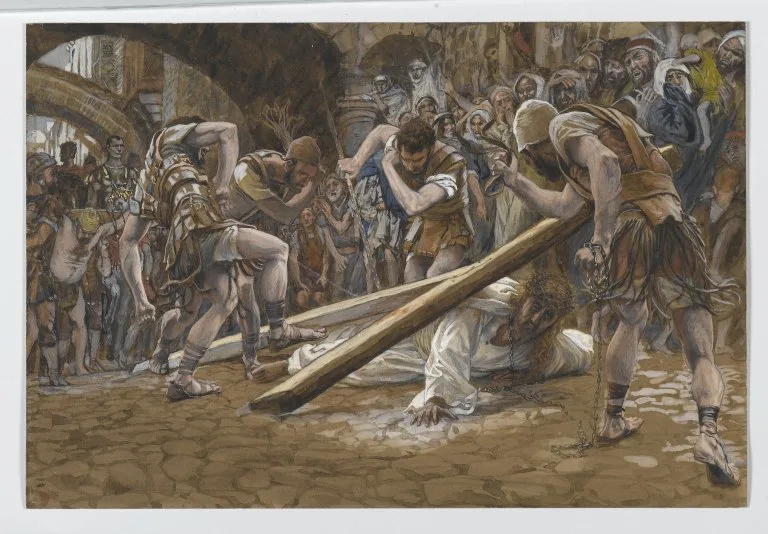
Jesus Falls Beneath the Cross, by James Tissot, 1886–94. James Tissot, Public domain - About 9 a.m.Nailed to the cross
At a place called Golgotha, they drove iron nails through his hands and feet.
Crucifixion was designed to kill slowly. To take a breath, a man had to push himself up on his nailed feet. Every breath hurt.
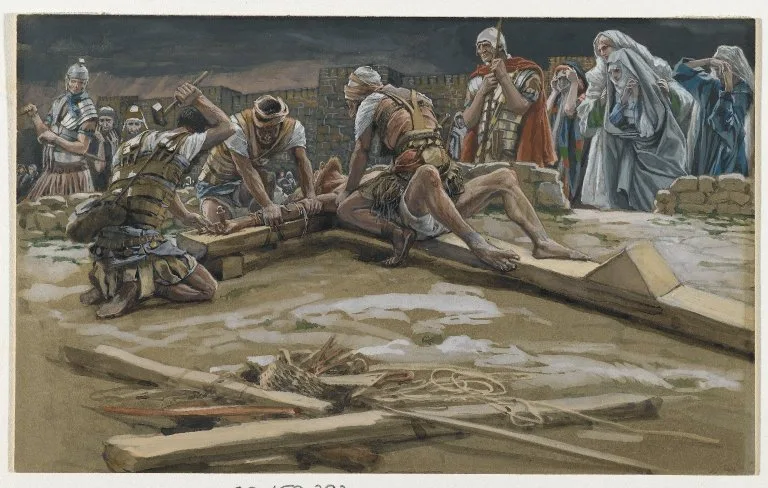
The First Nail, by James Tissot, 1886–94. James Tissot, Public domain - The next six hoursOn the cross
People walking past mocked him. The soldiers gambled for his clothes.
And his words were: Father, forgive them, for they don’t know what they are doing.
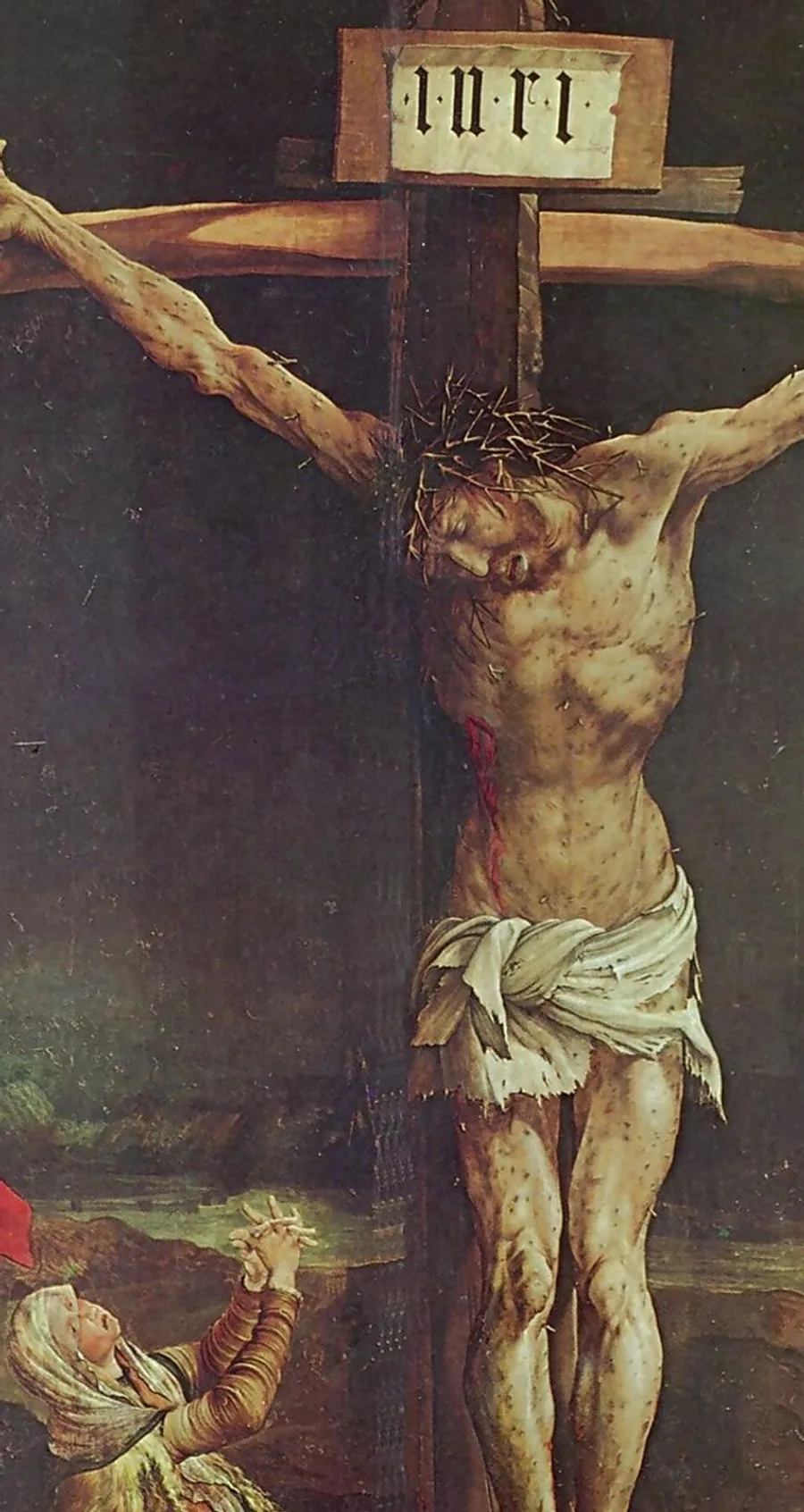
Jesus on the cross, from the Isenheim Altarpiece by Matthias Grünewald, around 1515. It was painted for a hospital, so that the dying could see that he had suffered as they did. Matthias Grünewald, Public domain - About 3 p.m.It is finished
Darkness had covered the land. He cried out, My God, my God, why have you forsaken me? Then, It is finished. And he died.
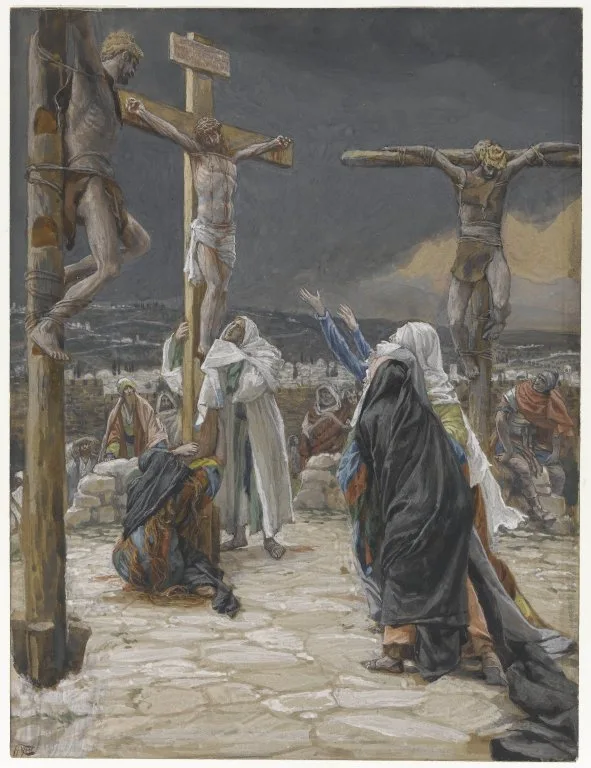
The Death of Jesus, by James Tissot, 1886–94. James Tissot, Public domain
The cry from the cross
That cry from the cross wasn’t him giving up. Remember the prophecies we went through earlier, and the odds? This is one of them.
My God, my God, why have you forsaken me? is the first line of 22, a song written about a thousand years earlier, traditionally by King David. Jesus was quoting it on purpose.
Back then nobody had chapter numbers. If you wanted to point people to a psalm, you said its first line. Everyone there who knew their Scriptures, and most of the crowd did, would have heard it and known exactly which song he meant.
And that psalm describes a man being executed. All who see me mock me… “He relied on the Lord, let the Lord rescue him.” They have pierced my hands and my feet. They divide my garments among them; for my clothing they cast lots.
Every line of it was written a thousand years before that afternoon. Of all the prophecies, this is the one that got me most.
Read it at the foot of the cross and it’s hard to breathe. It was all happening right there, in front of them.
So with his last strength, Jesus was telling them: this is who I am. This was written about me. And the psalm doesn’t end in despair. It ends with God rescuing the man, and all the nations turning to him.
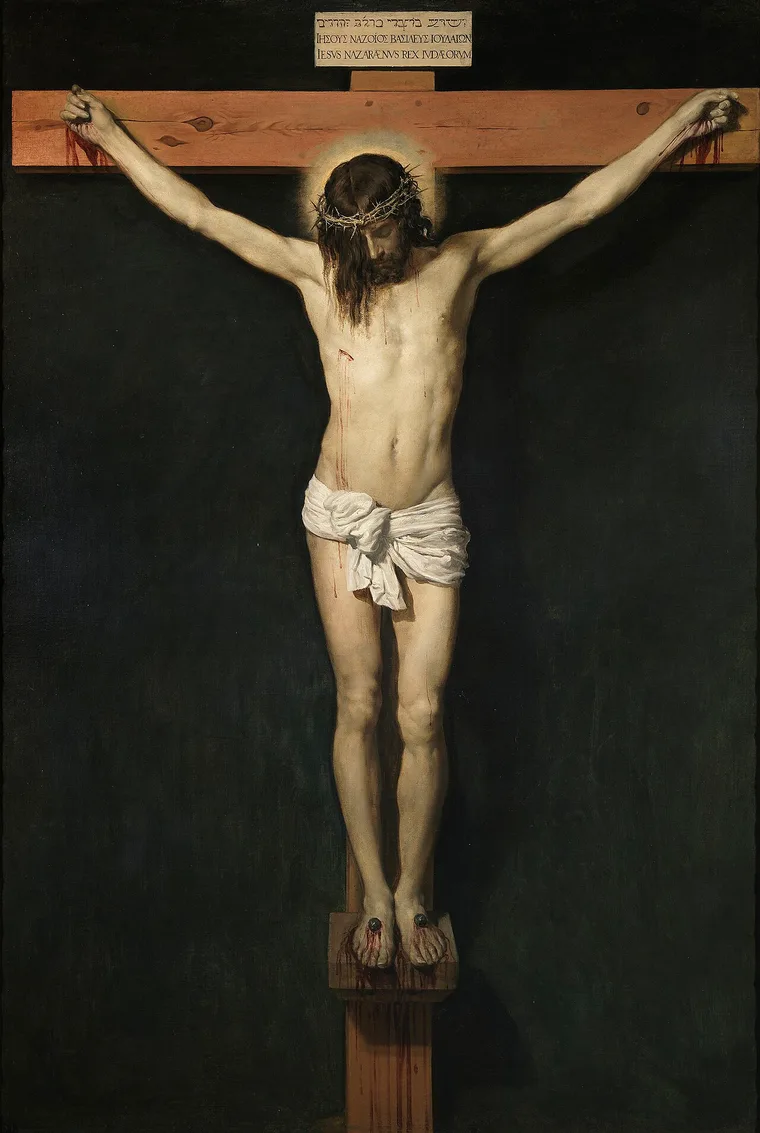
And here’s what gets me every time. He could have stopped it at any moment. He said himself that he could call on his Father, and more than twelve legions of angels would be there. He didn’t. All of it, for us.
It was the plan
This is the part I didn’t really understand for most of my life. The cross wasn’t a tragedy that got in the way of God’s plan to rescue us. It was the plan.
Jesus was the real lamb, the one every other lamb had been pointing to. And this time, the sacrifice was finally enough. Here’s why.
Remember the problem: we’ve all walked away from God, and we can’t fix it from our side.
Being a good person doesn’t close the gap, the same way giving to charity doesn’t undo stealing $10,000 from a friend.
And remember what a sacrifice needs: someone with no fault of their own, to stand in our place. But there was nobody like that. Every one of us has done wrong, and keeps doing it.
And even if there were one perfect person, their life could only stand in for one other life. It would never be enough for all of us.
Why his life was enough
Now look at who Jesus is. Fully human, so he can truly stand in our place. Without , so he owes nothing of his own.
And fully God, so his life isn’t worth just one life. It’s worth more than all of ours put together.
Think of it like an equation that finally works. A perfect human could pay for one person. But a perfect human who is also God?
That payment is multiplied by infinity: enough for every person who has ever lived, once and for all.
Did it have to be this way?
Here’s something that surprised me. You might ask: did it have to be this way? Couldn’t God have saved us some other way?
Honestly, the Church’s own great thinkers say yes. , one of the most respected theologians in Catholic history, wrote that God could have saved us another way, and it wouldn’t have been unjust.
So why the cross? Because it was the most fitting. God chose a way we could actually understand.
Think about how you know someone really loves you. It’s not from what they say. It’s from what they’re willing to go through for you.
So God didn’t stay far away and forgive us from a distance. He came as one of us, and went through everything we go through. He was hungry and tired. His own family misunderstood him. A close friend betrayed him. He was mocked, beaten, afraid, and alone. And then he died.
So whatever you’re going through, he’s been there. The says we don’t have a God who can’t sympathise with our weaknesses, but one who was tested in every way we are (Hebrews 4:15).
That’s the first reason Aquinas gives, and it isn’t about payment. It’s that when we see what he went through for us, we finally get how much he loves us, and we want to love him back.
Remember the dad at the hospital bed? His son had walked out on him, and partying had wrecked the son’s liver. Nobody made the dad give anything. He forgave his son for free, and then gave part of his own liver to save him.
That’s the cross. God, the one we wronged, didn’t make us suffer for it. And Jesus went further than any dad could. He gave not part of himself, but his whole life.
The two gardens
The night before Jesus died, he prayed in a garden, and that is no accident. The Bible tells the story of two gardens: the first, where went their own way, and , where Jesus prayed before he died.
Put them side by side and you can see it:
Where the first man’s my way broke the relationship, Jesus’s your way, all the way to death, fixed it.
Remember why we die: because we sin. Jesus never sinned. Death had no claim on him at all, and he walked into it anyway.
Jesus, God himself and without any sin, died the death that was ours.
The third day
And because death had no right to him, it couldn’t hold him. Three days later, he rose. That was checkmate on death. The door that was shut in the garden is open again.
The Eastern Churches, like the , have always put this part first: the cross as beating death, not just paying a debt. I believe both are true.
He didn’t just show us the way back to God. He became the way back. That’s what redemption means.
And that is just a glimpse of how much God loves us. Every so often we see it on the news: a parent who dies saving their child, a stranger who jumps into the water to pull someone out.
Our God did that, for all of us. The depth of that love is just… indescribable.
So what does the cross actually open up? This chapter is about that: the way back, how you walk it, and where it ends.
The bridge
This is the bridge back to God, how we cross it, and the seven sacraments that help us.
Because he is both God and human, Jesus is the one person who can stand on both sides of the gap. He is the spotless lamb that all those old sacrifices pointed to, and he is the bridge.
The way I picture it: on one side is God the Father, waiting for us to come home.
Think of the father in Jesus’s story of the prodigal son, who keeps watching the road for the son who ran off and wasted everything.
On the other side is us. In between is the gap we can’t cross on our own. Jesus is the bridge. And the , God himself at work in us, walks with us and guides us across.
- 1Us. On this side since the fall, made for God and far from him.
- 2The gap. Sin, and the death it brings. No one crosses it on their own.
- 3Jesus, the bridge. Fully God and fully human, so he stands on both sides. The cross is what spans it.
- 4The Holy Spirit. Walking with us, and giving us the strength to cross.
- 5The Father. Waiting at home, watching the road for us.
Crossing the bridge
So does that mean you can believe in Jesus and then do whatever you want? No way.
Crossing the bridge isn’t a one-time click. It’s a walk, and it takes a strength we don’t have on our own. The calls that strength : God’s help, given for free.
But God won’t drag anyone across. Remember the garden, where the first people went their own way: love that’s forced isn’t love. God moves first, and even our yes is his gift. But the Holy Spirit works with us when we choose to work with him. Every day, it’s a choice to keep walking.
The seven sacraments
That’s what the Church is for. It shows us how to cross, and it hands us God’s help in ways we can actually see and touch.
The Catholic Church calls them the seven . Seven moments where God’s invisible help comes through something real: water, oil, bread and wine, spoken words, a hand on your head.
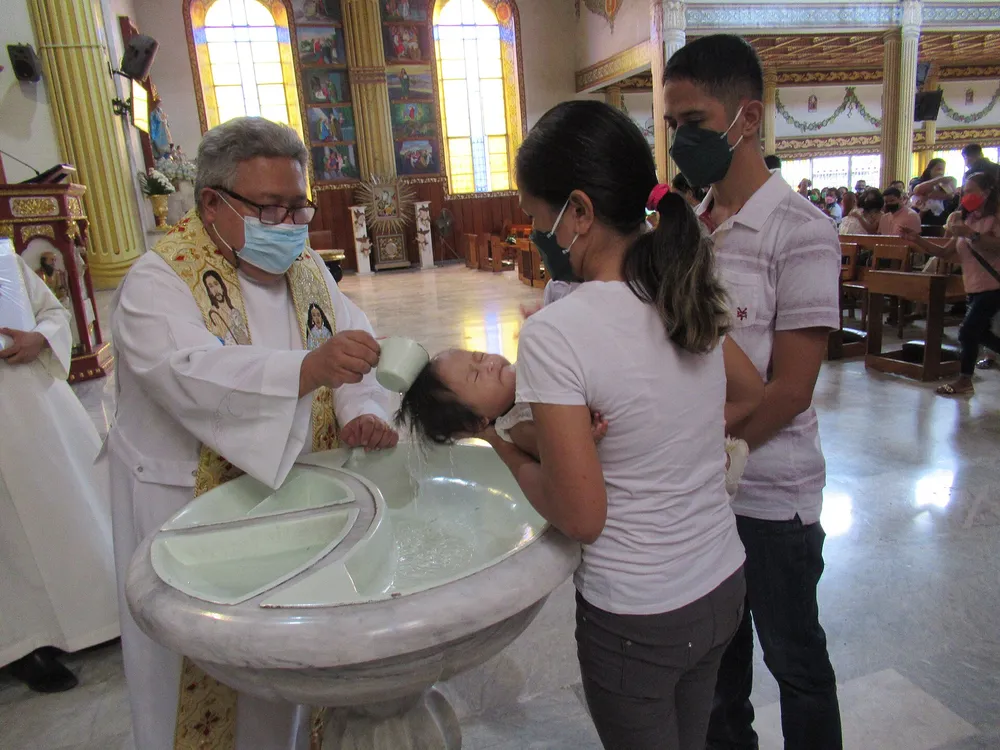
Where it all starts.
Water is poured over you in the name of the Father, and of the Son, and of the Holy Spirit, just as Jesus told his apostles, the closest followers he chose and sent out, to do.
It takes away that inherited sin from the garden, makes you God’s child, and gives you the Holy Spirit.
The habit of putting yourself first doesn’t vanish, but now you have help against it.
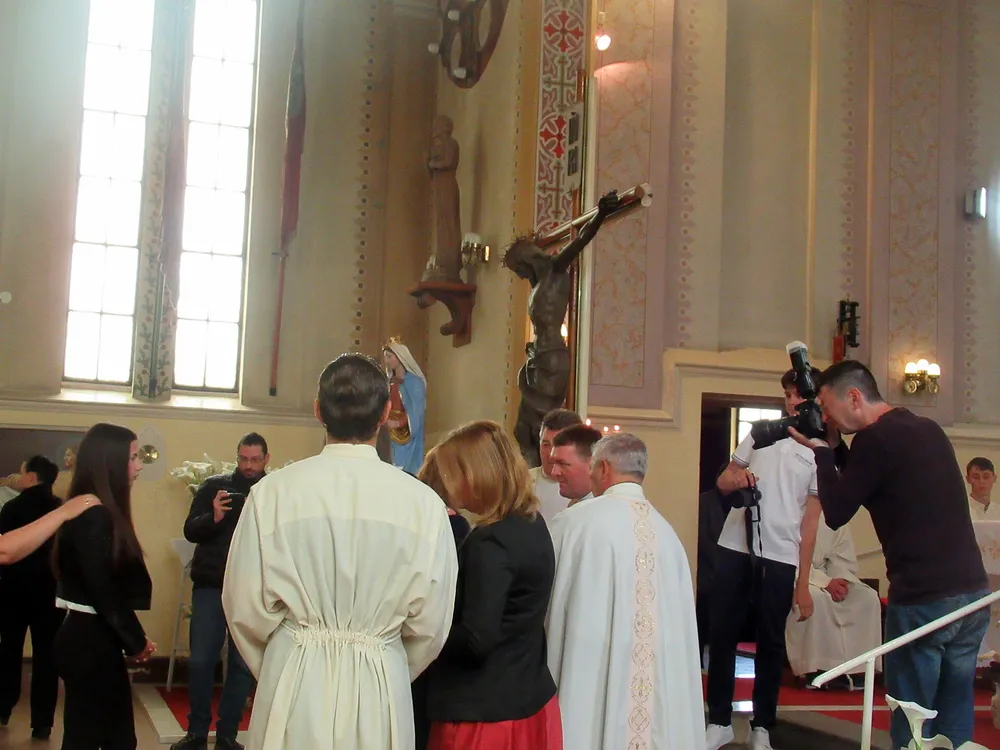
A bishop, who leads the Church in an area, lays his hands on you and anoints you with oil, like the apostles did in the early Church.
The Holy Spirit strengthens you to live your faith out in the open, not just in private.
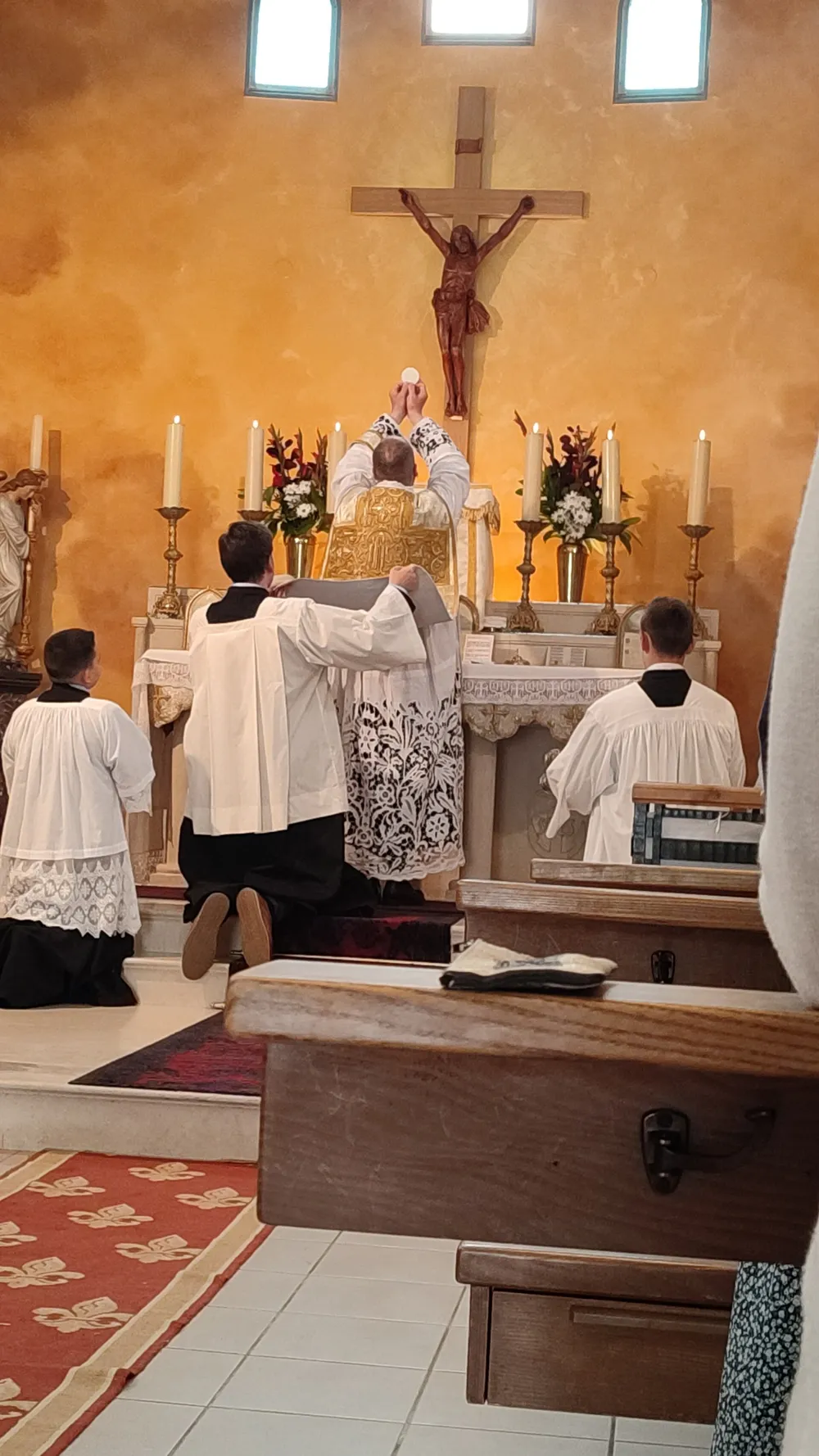
At the Last Supper, his last meal with his friends before he died, Jesus took bread and said, this is my body.
Catholics believe that at every Mass, the Catholic Sunday service, the bread and wine really become Jesus himself. Receiving him is how he feeds us for the road, week after week.
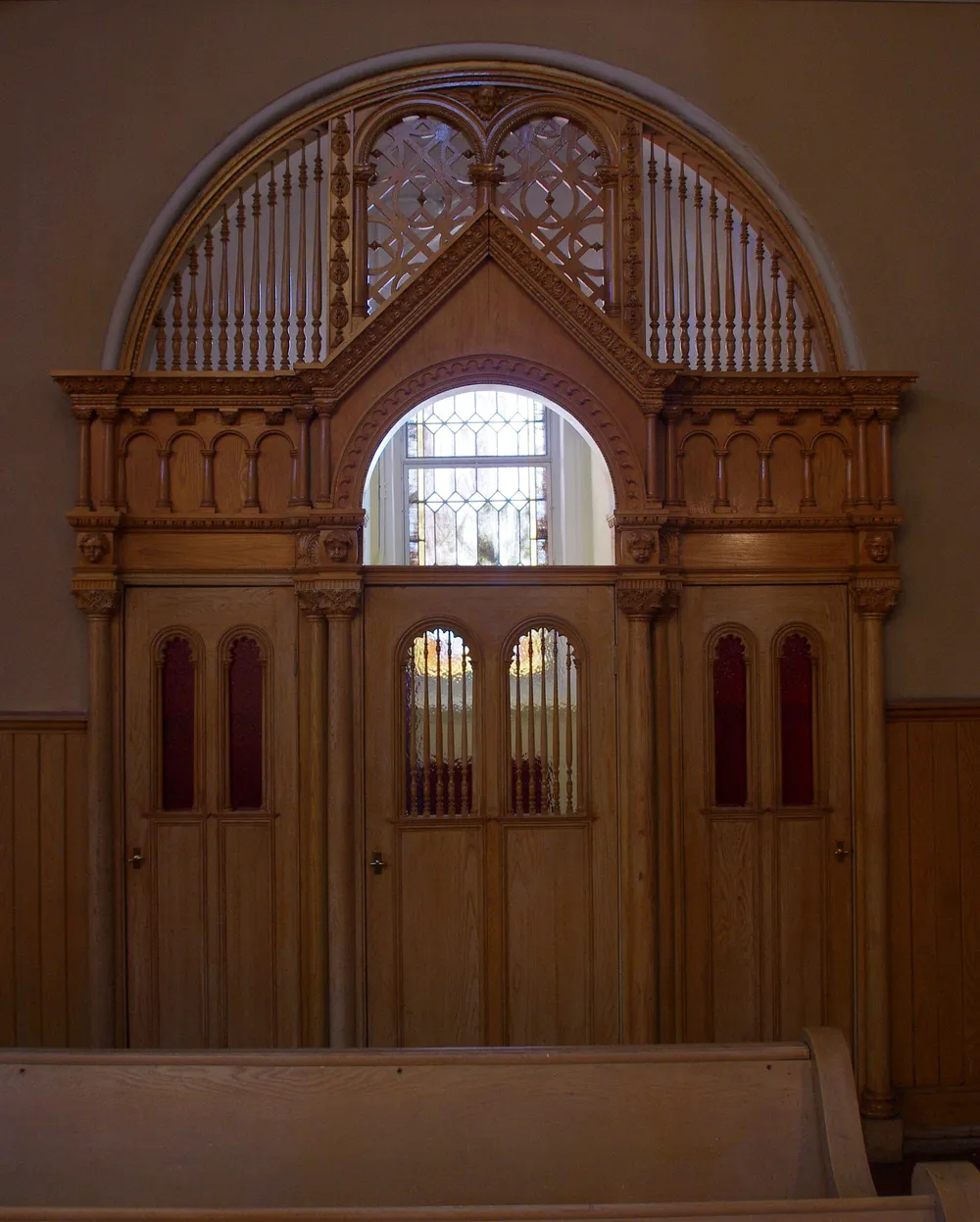
Everyone falls, even after crossing. Jesus gave his apostles the power to forgive sins in his name, and that power was handed down to priests.
So you sit down with one, say honestly what you’ve done, and hear the words I absolve you. Why in person? Because we’re human. Think of a friend you’ve hurt.
It’s one thing to assume they’ve let it go because they never bring it up. It’s a completely different thing to hear them say I forgive you to your face.
One leaves you guessing. The other is a weight off your chest, and it gives you the strength not to do it again.
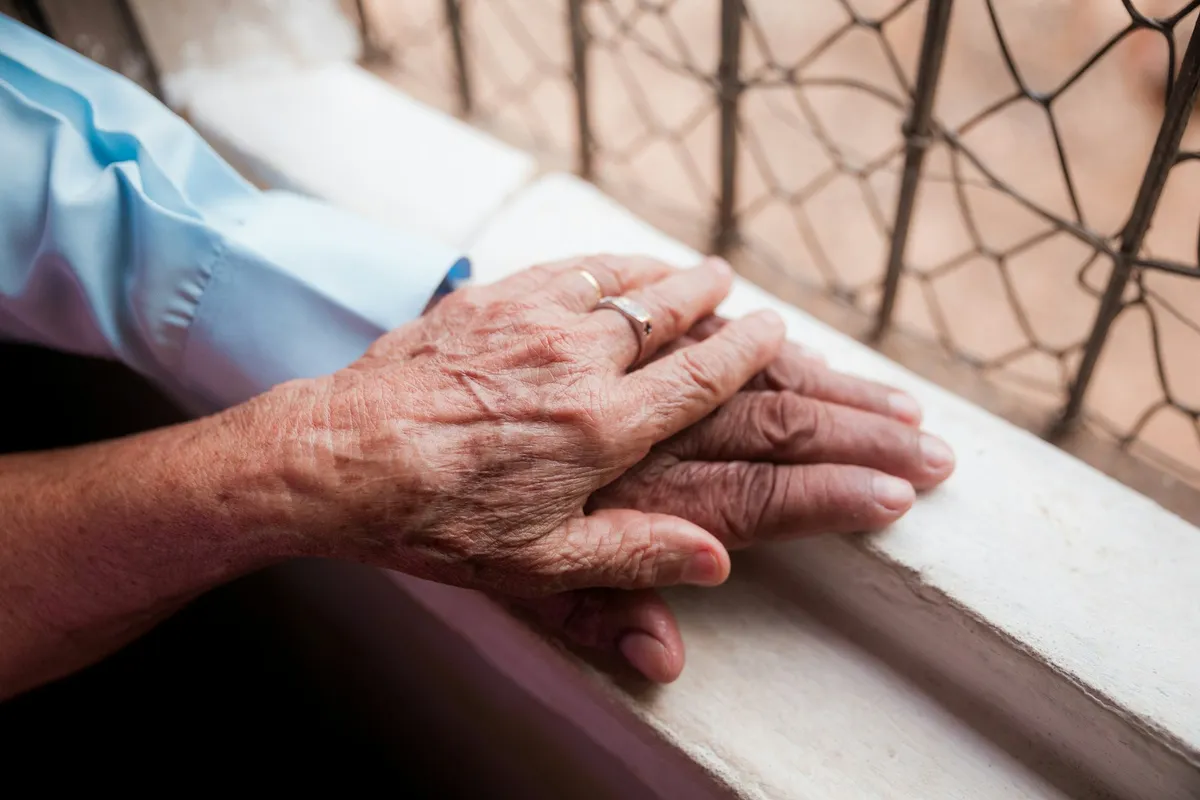
For the seriously ill, the elderly and the dying. A priest prays over them and anoints them with oil, just as the apostle James told the first Christians to do.
It brings strength, peace, and sometimes healing.
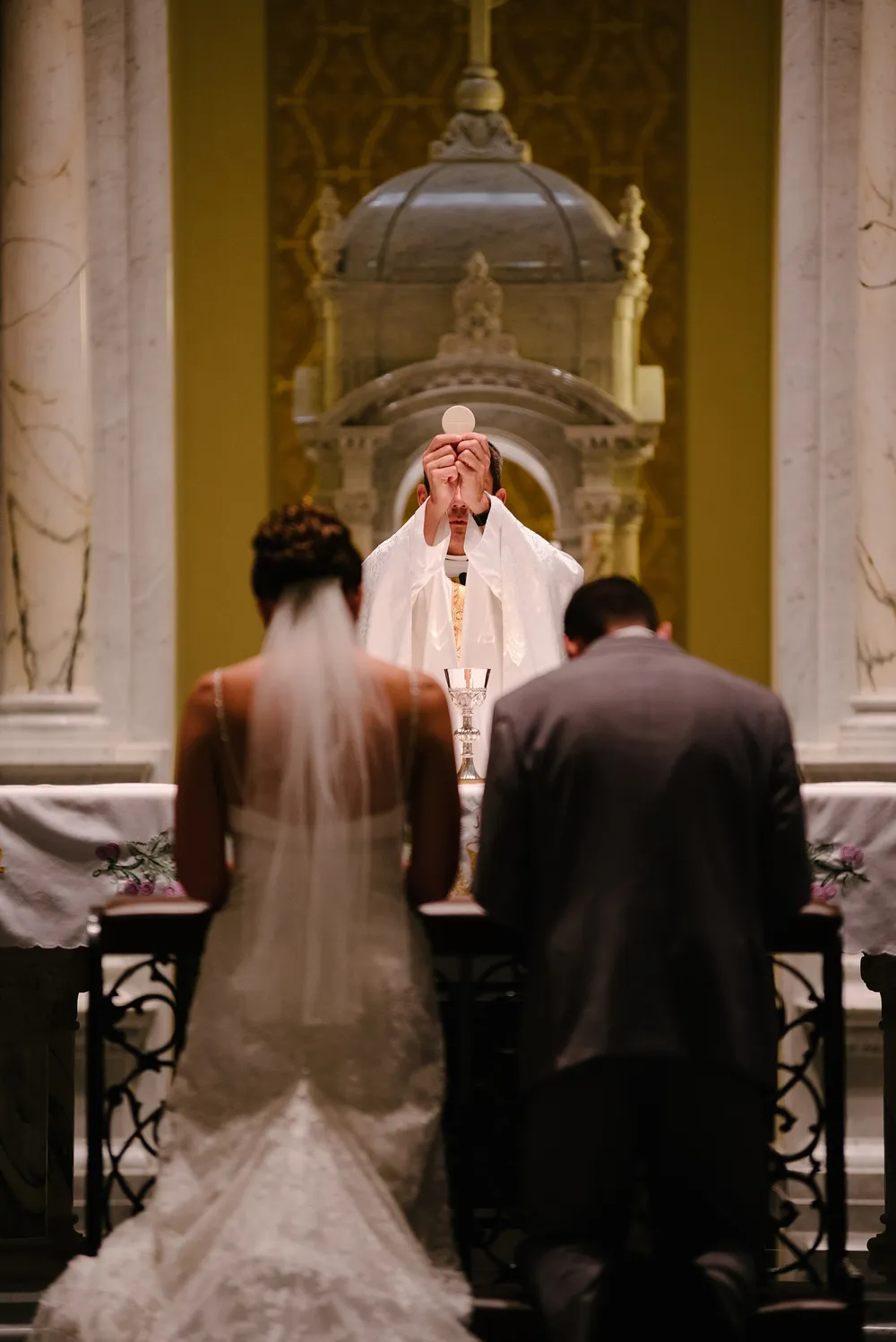
A man and a woman promise their whole lives to each other, and God becomes part of that promise.
It’s meant to be a living picture of how God loves us: faithful, for keeps, and holding nothing back. And notice what God’s love does. It creates.
The whole universe exists because his love wanted to be shared. Marriage is built the same way: a love so full that it naturally opens out into new life.
That’s why the Church says marriage is ordered towards children.
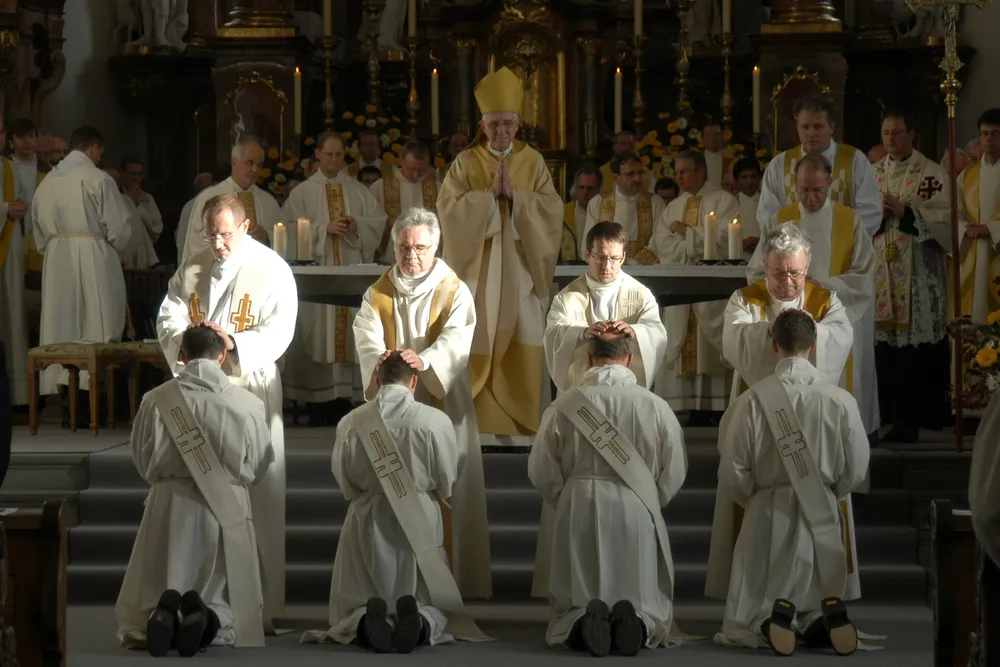
Men are set apart as deacons, priests and bishops, in a line going all the way back to the apostles.
They’re set apart to teach, to celebrate the sacraments, and to care for people.
The unnatural becomes natural
And here’s the part that surprised me. Honestly, living it out feels unnatural at first. The world says an eye for an eye, and that violence is sometimes justified.
Jesus says the opposite: love your enemies, and pray for the people who hurt you. On our own, that’s impossible.
But when you let God work with you, slowly, what used to feel unnatural starts to come naturally.
Forgiving instead of holding a grudge. Letting go of the gossip. Choosing peace over getting even. Not because you’re forcing yourself, but because something inside you is actually changing.
Here’s roughly what that change looks like, from the inside:

Imagine you spent two weeks on a deck for a client. The night before the pitch, a colleague asks for the file to have a look.
The next morning, in front of your boss, he presents it as his own. Your name isn’t on a single slide.
You say nothing in the meeting.
But you replay it in the shower, in the car, at 2 a.m., and every time you come out of it more right.
You tell the story to three friends, and it gets a little worse each time.
Months later, his name in a group chat still makes your jaw tighten. You haven’t spoken to him properly since, and you tell yourself that’s fine.
The sting is still there; that doesn’t go away. But a few days in, you catch yourself praying for him, and actually meaning it.
You start to notice he’s under pressure too: a new baby, a boss who shouts.
None of that makes what he did okay. So you still raise it with him, calmly, because it mattered, and you tell your boss the deck was yours.
And one day you realise the knot in your stomach is gone, and you didn’t even notice when it left.

Imagine lunch with the team. Someone brings up the new girl, the one who joined last month.
She messed up a report on Tuesday and the boss had to redo it. Someone does an impression of her, and everyone laughs.
You add a story of your own, about the time she asked you the same question twice.
Honestly, it’s fun, and it makes you feel part of the group. You call it sharing concerns.
By the end of lunch you’ve said two things about her you’d never say to her face, and you’d be mortified if she heard them.
She’s eating alone at her desk.
Imagine the same lunch. The impression starts, and something in you winces.
You remember your own first month, and how long it took you to get anything right.
You picture her as someone God loves as much as he loves you, and the words don’t come.
So you change the subject, or you just say she’s not here to answer that. The table goes quiet for a second.
It costs you a little. It stops costing her. That afternoon you walk over and ask if she wants help with the report.

Imagine you’re on the PIE, and a car cuts in front of you so close you have to brake hard. Your coffee goes everywhere.
Then the driver winds down his window and gives you the finger, like it was your fault.
Even if you’d never actually do anything, you want to. You honk back, and you’re angry for the rest of the drive.
You imagine him getting pulled over at the next exit, or hitting a divider, or getting what’s coming some other way.
The whole world tells you that’s only fair, and honestly, it feels fair. You’re still telling the story at dinner.
Imagine the same moment: the brake, the coffee, the finger. You feel the heat rise in your chest, and then you hand it over.
He’s yours, not mine. Not because he deserves to get away with it, but because you know it’s not your job to teach him a lesson, and you trust God with it.
You let him go. Your pulse settles by the next exit.
You arrive home without the story, and nobody at home hears about it, because there’s nothing to tell.

Imagine the bonus lands. Five figures, more than you’ve ever had at one time. For about a week it feels like enough.
Then a colleague drives in with a new car, and suddenly your car looks old.
The target moves. Now it’s the next pay rise, the next phone, the bigger flat, the holiday your friends posted about.
You hit each one, and you feel exactly the same as before, for about a week.
You never stop to ask why the feeling keeps running out.
Imagine looking at what you already have and feeling, for once, that it’s enough. Often more than enough.
The flat is warm, the fridge is full, your family is in the next room. You still work hard and you still save.
But the bonus stops being the whole point. Giving some of it away stops feeling like a loss and starts feeling like a privilege.
You hold what you have with an open hand, because you know where it came from.

Imagine the auntie at the chicken rice stall who takes forever to give you your change. The colleague who talks too much in every meeting.
The stranger who shoves onto the MRT before you can get off. To you, most people are background noise. A few are competition.
And the ones who annoy you, you write off in seconds: slow, annoying, rude. You’d never say it out loud.
But it’s quiet and it’s constant, and it decides how you treat them.
Imagine seeing those same people and catching, just for a second, the image of God in them.
The auntie has been on her feet since five in the morning. The colleague talks because he’s lonely.
The stranger is late for something that matters to him, maybe a hospital. You don’t manage it every time. Some days you still mutter.
But you catch yourself, and you start to look people in the eye, and that’s new.

Imagine it running your life quietly. It’s in the health checks you obsess over, and the results you read five times.
The holiday you won’t book, in case something happens on the plane.
The lump you’ve had for two months and won’t get looked at, because you don’t want to know.
The questions you won’t let yourself ask at night: what happens after, is this all there is.
You keep busy so you never have to look at it straight.
Imagine it still showing up some days, because it does.
But it doesn’t own you any more, because you finally know what’s on the other side of it, and who’s waiting there.
So you get the lump checked. You book the holiday. You sit with the questions at night, and they don’t crush you.
You can look at it straight.
And let me be clear about what this is and isn’t. None of this is someone faking it to earn their way into . You can’t earn it. Nobody is keeping score.
It’s the other way round. These changes are what naturally grows in you when you follow the way of . Plant a tree in good soil and you don’t have to force the apples. They just come. The Bible’s word for it is fruit.
It’s also why people sometimes say Christians have a certain vibe about them. That’s what they’re noticing.
And none of us are done. Some of us are there on a few of these. Some are still struggling with all of them, and I’m in that group more days than I’d like. That’s not failure. That’s the journey. Remember the bridge? We’re all somewhere on it, still crossing.
Which is why those seven sacraments matter so much. They’re not rituals to tick off. They’re where God’s help becomes something you can see and touch, and they’re there every single week to give you the strength to keep going. Confession is there when you’ve fallen. The , the bread and wine of , is there when you’re running on empty. That’s what keeps me on the bridge.
Two thousand years of it
And this isn’t just theory. Look at what it has looked like across two thousand years:
One of the first deacons, chosen to make sure the poor widows in the Jerusalem church got their share of food.
He also preached about Jesus, and the religious leaders put him on trial for it. He didn’t back down. They dragged him outside the city and stoned him to death.
A young man named Saul stood watching, holding the coats of the men throwing the stones.
And as the stones hit him, Stephen knelt down and prayed for them: Lord, do not hold this sin against them. He died praying for the people killing him. Saul later became Paul, the man who wrote much of the New Testament, which is the part of the Bible written after Jesus.
The son of a rich cloth merchant in Italy. As a young man he wanted parties, fine clothes and glory as a knight.
Then came war, a year in prison and a long illness, and the old life stopped satisfying him.
He had always found lepers disgusting; he wrote later that even the sight of them was bitter to him.
One day, riding outside Assisi, his home town, he met one on the road. He got off his horse, gave him money, and kissed his hand.
When his father dragged him before the bishop to give back the family’s money, Francis gave it back, along with the clothes he was wearing.
He spent the rest of his life poor, with the poor, and the brothers who joined him became the Franciscans.
An eleven-year-old girl from a poor farming family near Rome. A nineteen-year-old neighbour, Alessandro, tried to force himself on her. She fought him off, and he stabbed her fourteen times.
She lived for about a day in hospital. Before she died, she said she forgave him, and that she wanted him with her in heaven.
An eleven-year-old, forgiving the man who killed her. Alessandro went to prison, unrepentant for years. Then, he said, she came to him in a dream, and he broke.
When he got out, he went to her mother and asked for her forgiveness, and she gave it.
In 1947 he was in the crowd in St Peter’s Square in Rome when the Church declared Maria blessed, the step before sainthood.
He spent the rest of his life working at a friary, which is a house of Franciscan brothers.
A Polish Franciscan priest who ran a printing press that reached hundreds of thousands of readers. The Nazis arrested him and sent him to Auschwitz, their death camp in Poland.
One day a prisoner escaped, and as a punishment the guards picked ten men to be starved to death.
One of them, Franciszek Gajowniczek, cried out: my wife, my children! Kolbe stepped out of the line and said he would take his place. Who are you? the officer asked.
I am a Catholic priest. The officer agreed. In the starvation bunker, Kolbe led the other men in prayer and hymns.
After two weeks without food he was still alive, so they killed him with an injection. Gajowniczek survived the war, went home to his family, and lived to 93.
He was there in Rome in 1982 when Kolbe was declared a saint.

An Albanian nun who taught at a girls’ school in Calcutta, India, for almost twenty years.
In 1946, on a train, she felt God calling her to something else: to serve the poorest of the poor.
She left the school, started a new order of sisters, and opened a home for the dying, people picked up off the streets that nobody else would touch.
She washed them, sat with them, and made sure they died knowing someone loved them. After she died, her letters showed something nobody had known: for almost fifty years she had felt God was far away, and she kept going anyway.
Her homes have also been criticised for the standard of their medical care, and that’s worth reading about too. But the love was real, and it was costly.
John Paul II was the pope, the head of the Catholic Church, from 1978 to 2005.
In May 1981, in front of a crowd in St Peter’s Square, a gunman named Mehmet Ali Ağca shot the pope at close range.
The bullets tore through his stomach; he lost a huge amount of blood and nearly died. Days later, still in hospital, he said he had already forgiven the brother who shot me.
Two years later he went to see Ağca in his prison cell in Rome.
They sat close together and talked quietly for about twenty minutes, the pope holding the hand of the man who had tried to kill him. He didn’t just say he forgave him. He went and sat with him. Years later he met Ağca’s mother too, and Italy eventually pardoned him.
Pictures: Stephen, Bulgarian icon (Velko Iliev, public domain); Francis, fresco by Cimabue; Maria Goretti, painting by Giuseppe Brovelli-Soffredini; Maximilian Kolbe, 1936; John Paul II, White House photo (all public domain); Mother Teresa, photo by Kingkongphoto, CC BY-SA 2.0. Via Wikimedia Commons.
Two thousand years of it
This is what happened to people who crossed the bridge, from the first martyrs to today.
And these are just the famous ones. The same thing is happening quietly in ordinary people, in ordinary parishes, all over the world.
And it isn’t only Catholics. Corrie ten Boom, a Dutch who survived a Nazi camp, later shook the hand of one of its guards and forgave him.
The 21 men killed for their faith on a beach in Libya in 2015 were Coptic , from the ancient church of Egypt. The doesn’t check denominations.
Not alone
And you don’t do it alone. We have the whole family of believers, which the calls the body of , and even Mary, Jesus’s own mother, who is our mother in too.
They’re all praying for us and cheering us on every step of the way. It’s just so beautiful.
How it ends
This is where we are in the story now, how it ends, and why the ending gives me peace instead of fear.
Where we are now
So where does that leave us today? Here’s the whole story on one line:
- Made for closeness
Everything good. People close to God, to each other and to creation.
- We walked away
Adam and Eve trust themselves over God, and the relationship breaks.
- God works with us
Promises, covenants, prophets and lambs, across the whole Old Testament.
- God comes himself
Jesus lives, dies on the cross as the real lamb, and rises again.
- The bridge is openWe are here
The Holy Spirit is with us and the Church shows us the way across.
- Everything made new
Jesus comes back. Every wrong put right, no more death, no more tears.
We’re living in the open-bridge part of the story. Jesus has risen and gone back to the Father. The , who is God himself, is here with us.
And the Church is doing its job of helping people across. Anyone, anywhere, can cross.
What’s the point of it all?
So what’s the point of all this? Why would God go to so much trouble?
Because he made us for himself. He didn’t make us as robots or as servants, but as his children. The whole story, from the garden of Eden to the cross to the very end, is about one thing: getting us home.
How it ends
And the story has an ending. One day Jesus will come back, and it will end where it began, only better.
The says God will wipe every tear from our eyes, and there will be no more death, no more grief, no more pain.
Remember what we were made for? That’s exactly where it ends. Every relationship that broke in the garden will be made whole again:
And isn’t sitting on clouds playing harps forever. The Bible describes it as seeing God face to face. It’s being fully alive, the way we were always meant to be, with no fear, no shame and no distance.
Justice, in the end
That’s also where real justice finally happens. At the end, every wrong will be put right. Christians call it the final judgement, when everything ever done comes into the light.
So if you look at the evil in the world and think God is doing nothing, and that evil will get away with it, it won’t.
But it’s just as wrong to say that we ourselves are fine. We’ve all walked away from God too, and the consequence of that is death.
Jesus, who is God and had no , took that consequence on himself, so that you and I could have a way back to God. That is humbling.
But if Jesus already took our wrongs on himself, what’s left to judge? At the cross, his mercy was offered to every single person. At the end, each of us meets the truth, and the judge is Jesus himself.
Whoever accepts his mercy is forgiven, because their wrong was already paid for at the cross. Whoever keeps refusing it, God won’t force it on them. He takes our yes and our no that seriously.
So the ending isn’t something to dread. It’s about liberation. Nothing evil gets waved away, and nobody is forced. It’s true justice, and real mercy, and love, all at once.
What about hell?
So what about ? It isn’t do A, B and C, or else.
Here’s what the Catholic Church actually teaches. We can’t be united with God unless we freely choose to love him.
The , the Catholic Church’s official summary of its teaching, describes hell as a person’s definitive self-exclusion from with God. That means shutting yourself out, for good, from the very love you were made for.
God predestines no one to go there, meaning he never picks anyone for it in advance. God doesn’t throw anyone there. It takes a person deliberately turning away from him, and refusing to come back, right to the end.
The Church teaches that hell is real and lasts forever. It has never said that any particular person is there.
And here’s how I understand it. To me, there’s even a kind of mercy in it. Picture a soul that has spent its whole life building itself on pride, on me, my way. By the end, that pride is all it has left to hold on to.
For a soul like that, standing in the full light of God’s love would be unbearable. It’s like someone who has lived in a dark room for years being dragged out into the midday sun. It would only hurt.
So God doesn’t force it. He lets that soul have what it actually wants: to be apart from him. And even there, he keeps it in existence. He respects that choice to the very end.
That’s the hard side of free will, and the mercy in it.
Not fear. Peace.
That’s why following Jesus isn’t about obeying rules for the sake of it. It’s about understanding how deep his love goes.
Yes, there’s a kind of fear in it: the fear of losing a relationship you treasure, the way you’d never want to hurt someone you love.
But you don’t live in fear. You live in peace. You’re full of love and full of joy. And honestly, I’m happy in a way I never knew before.
That’s what the Church means by heaven starting here on earth. The Church is the living body of in the world today, meaning Jesus is at work through his people.
And when we actually live out the gospel, which is the good news about Jesus, we become the light this world needs in the middle of all its darkness.
Until then, the point of our lives is to walk towards that, and to help anyone else who wants to find the bridge. Honestly, that’s why this site exists.
The step the evidence can’t take
This is how all the reasons came together for me, and the one step the evidence couldn’t take.
Why it all holds together
So let me bring it all together. For me, it was never one argument that did it. It’s that everything points the same way:
- The problem is real. Every belief I studied had to deal with the same thing: people do wrong, and doing good afterwards doesn’t cancel it out.You can see it on the news, in a toddler shouting mine, and if you’re honest, in yourself.Most answers either told me I was basically fine, or that it all balances out in the end. Christianity was the only one that called it what it is, explained where it came from, and showed me what God actually did about it.
- The story holds together, start to finish. A broken relationship in the garden of Eden, where the first people chose their own way over trusting God.A God who keeps his promises through , , , David and the prophets, who were the people he worked through before Jesus came. A lamb sacrificed again and again, pointing forward to Jesus.Then Jesus, the cross, the empty tomb, and an ending where everything is put right. Every chapter answers the one before it.
- Justice and mercy, both. Most answers give you one or the other: either the wrong gets punished, or it gets waved away.At the cross, where Jesus died, the wrong is fully paid for, and we are fully forgiven. Justice and mercy finally fit together.
- The evidence backs it up. Think about everything we’ve looked at: hostile Roman historians, thousands of manuscripts, stones in the ground with the right names on them.And there were witnesses named while they were still alive, and prophecies written centuries before Jesus was born.This isn’t a story set once upon a time.
- It changes people. Frightened fishermen, Jesus’s first followers, who died rather than deny that he rose. A persecutor, , who became Christianity’s greatest preacher.Two thousand years of saints, from Stephen, the first Christian killed for his faith, to Mother Teresa. Ordinary people, still, today. And me.
- It answered my own fear. I started all of this terrified of dying.Christianity didn’t just tell me something comforting. It told me why death exists, what God did about it, and where the story ends.
Examining the evidence and studying the people was great. Intellectually, it all made sense. But that’s not what changed me.
The step the evidence can’t take
Logic is only one side of it. The evidence is there, and it’s stronger than I ever expected, but what we’re talking about is unseen. At some point you still have to take a leap of faith.
It’s not blind faith. It’s faith with its eyes open, standing on everything the evidence can give you, and then taking the one step the evidence can’t take for you.
That step is trust: handing your life over to a God you can’t see.
For me, that step wasn’t one prayer on one night. It was a long, hard process of surrender, spread over the best part of two years. For the first time in my life I read Scripture seriously.
And then it clicked. I saw that at the core of all of it, under the history and the arguments, was love. It was the depth of the love of : that God would become one of us and die on a cross, for you and me.
God’s love went straight through the walls I had built my whole life, and they melted. I cried. That love is what I most want to share with other people.
The world looked different after that. I saw colours differently. I saw the world differently. It was like seeing the world in colour after living in black and white. I don’t see people as just people any more.
Every single person is made in the image of God. It changed how I see the world, and how I move through it.
And for the first time, I knew why I’m here. A good career, a home, money in the bank, good experiences: those things are good. But they were never meant to be the centre.
The centre is to know God, to love him, and to love the people around me. Everything else finds its place around that.
I still get the odd bad day with the anxiety, and I won’t pretend otherwise. Therapy calmed my body. But the fear underneath it, the fear of dying that started with the office fire, was still there.
God’s love is what finally reached it. The fear doesn’t run my life any more.
Following the trail back
This is the detour I took into the rapture, and what I found when I read what the first Christians actually wrote.
Once I believed Jesus is who he said he was, the next question came almost straight away: where is the Church he started?
Some of the first people who helped me think seriously about Christianity were writers and speakers who make the case for the faith: Nabeel Qureshi, David Wood, Wes Huff, and Cliffe and Stuart Knechtle.
Cliffe and Stuart are the father and son who take people’s hardest questions on university campuses.
There was Bear Grylls, the TV survival adventurer, of all people, and his book about his faith. There was the Ear to Hear channel, and plenty more.
I’m grateful to every one of these teachers. They showed me that faith and evidence aren’t enemies, and they taught me to ask for sources.
The rapture
For a while, I was especially caught up in one idea: the .
Looking back, I had picked it up from some of the Protestant teachers I was watching, without even realising. The rapture is the belief, popular in some evangelical churches, that believers will suddenly be caught up to meet Jesus in the air, leaving everyone else behind to face a time of great trouble called the tribulation.
Pre, mid, post
Even the people who believe in the rapture argue about when it will happen. Pre-tribulation says believers are taken before the trouble starts. Mid-tribulation says halfway through. Post-tribulation says at the very end, and some claim that one is basically what Catholics teach.
A lot of these end-times teachers also say the Catholic Church will be corrupted in the last days and lead people astray. I took all of it seriously, and I worried about that last part myself.
When I was sure it was coming
There was a stretch when I was completely convinced the rapture was about to happen. So many signs seemed to line up.
Spiritually I felt ready, even happy about it. But my body wasn’t. As the day I expected got closer, I was filled with fear and trembling, because the flesh doesn’t want to go.
I also looked at the people around me who believed it too. Most of them were anxious. A lot of them were defeatist, like nothing in this life was worth building any more.
Honestly, it wasn’t a nice place to be. Something was off. If God really meant us to know the timing by reading between the lines of Scripture, why was knowing it making us more afraid, instead of more loving?
The mercy of not knowing
Looking back, it was a mercy that we don’t know when the end will come. If we did, our flesh couldn’t take it.
And that’s when I understood something about Jesus himself. Think of him again in , the olive garden where he prayed the night before he died. He knew exactly what was coming.
He told his friends his soul was sorrowful even to death. He begged the Father to let the cup of suffering pass from him, and he prayed so hard that his sweat fell like drops of blood.
Jesus was fully God, and fully human too, and the flesh itself doesn’t want to go through it. I had felt a tiny piece of that. I understood now.
What the Church actually teaches
That’s where the Catholic view first started to make sense to me. For the record, the Catholic Church doesn’t teach a separate rapture at all.
Jesus comes back once, at the end of time, in glory, for everyone to see. Before that, the Church itself will go through a final trial that shakes the faith of many. There’s no secret escape before it.
And Jesus said no one knows the day or the hour he will come back. It isn’t ours to know, or to obsess over.
Our job is to love God, and to love others the way Jesus loves us. That means living out the gospel, which is the good news about Jesus, right now. God gives us help for exactly that, in the , like and , and in prayer.
Getting the rapture wrong was a very humbling experience. I had been so sure. And it showed me how easily I could read my own ideas into the , and how much I needed something older and steadier than my own reading.
Digging deeper
So I went digging, deeper than before. Who chose the books of the Bible? What did the first Christians do on a Sunday?
What did the people taught by the , the closest followers Jesus chose and sent out, actually write?
That took me into the early Church, then the councils, which were the big meetings where settled disputes.
After that came 1054, when the Church split into the East and the Catholic West. Then came 1517 and the Reformation, when the Protestant churches began. And eventually I looked into Mary, Jesus’s mother, too.
What the first Christians wrote
The early Christians left a lot behind, and it surprised me.
Around AD 107, , the bishop of a big city in what is now Turkey, was marched under guard to Rome to be killed. He wrote letters to the churches on the way.
Ignatius wrote that the , the bread and wine of Communion, is the flesh of our Saviour Jesus . He told Christians to stay close to their bishop, the leader of their local church. And he’s the first person we know of to use a name I had heard all my life:
Wherever the bishop shall appear, there let the multitude [of the people] also be; even as, wherever Jesus Christ is, there is the Catholic Church.
Around AD 155, a Christian philosopher called wrote to the Roman emperor to explain what Christians actually did on Sunday. He was later killed for his faith, which is why he’s known as Justin Martyr.
Justin describes readings, a sermon, prayers, bread and wine brought forward, a long prayer of thanksgiving, the people answering “Amen”, and Communion. And about that bread and wine he says straight out:
For not as common bread and common drink do we receive these
I read that and thought: that’s the , the Catholic Sunday service.
Around AD 180, , a bishop in what is now France, listed the bishops of Rome in order, from Linus, who took over from the apostles, down to his own day.
Irenaeus said every church should agree with Rome, though scholars still argue over exactly what he meant by that.
The honest gaps
To be fair, not everything is as tidy as Catholics sometimes make it sound.
No first-century text calls , the leader of Jesus’s twelve apostles, the bishop of Rome. And the earliest lists of , meaning the bishops of Rome after Peter, differ in some details.
I would rather tell you about those gaps myself than have you find out later and feel misled. But for me, the direction of the evidence was hard to miss.
On the site: The Mass: AD 155 vs today · Christianity in AD 100 · Peter → Bishop of Rome → Pope · Who is Mary?
Where it led
All of that led me to the Catholic Church. I researched it heavily, from every side, because I didn’t want to just take anyone’s word for it. The evidence and the logic brought me to its door.
Just like believing in Jesus in the first place, it still took faith to walk in.
The way I see it, a lot of what Protestants object to in the Catholic Church comes from real misunderstandings. Those misunderstandings were held in good faith, because there really was corruption in the Catholic Church in the 1500s, when the Protestant churches began.
And some of it isn’t misunderstanding at all. There are real disagreements, over things like the Bible’s authority and the pope’s.
What I found wasn’t a debate to win. It was a family history, with saints and scandals on every branch.
Who decides?
This is about who settles a dispute over what the Bible means, Peter and Rome, and the corrupt popes.
I didn’t come back to the Catholic Church because I grew up in it. Plenty of people raised Catholic walk away, and for years I was basically one of them.
I came back because I put the Catholic Church through the same tests I had put every other belief through.
Does it make sense? Does it fit the history? Does it explain the world, and people? Does it change lives? It held.
Who decides?
The more I read, the more I saw that the real question underneath all the others is authority. It isn’t whether the is God’s word, because almost every Christian agrees it is.
The real question is this: when two sincere Christians read the same Bible and come away with opposite answers, who settles it?
Two churches, one relic
Here’s an example that made it click for me. In Acts, the Bible’s book about the first Christians, cloths that had touched , the great early preacher, were taken to the sick, and they were healed.
So one church looks at a saint’s , such as a bone or a piece of their clothing, and says God’s , which is his help, can flow through something like this.
Another church looks at the same relic and calls it idolatry, which means worshipping a thing instead of God. Both are holding a Bible. Both are sincere. So who’s right?
Arius and Nicaea
Or go further back. In the early 300s a priest called taught that Jesus wasn’t fully God. He quoted Scripture too, and a lot of people followed him.
What settled it wasn’t one man’s opinion. It was the of the Church, its leaders, meeting at Nicaea, a town in what is now Turkey, in 325.
The creed that came out of it, the short statement of what Christians believe, was finished at a second in 381. It’s the one we still say at , the Catholic Sunday service.
That’s the point for me. Without one way of settling disputes that everyone accepts, you get what we see today. There aren’t thousands of different gospels, but there are thousands of separate churches.
Many began when sincere people disagreed over what the Bible means, and saw no way forward except to start their own.
Every time we lean on our own understanding instead of what God handed down, we end up disagreeing.
And what God handed down is the Bible, and , which is what the , Jesus’s closest followers, handed on through their teaching and their way of life.
In the Catholic Church, both are guarded by its teaching office: the bishops together with the (the bishop of Rome), the point where unity holds.
And human disagreement is almost impossible to fix, because each of us is sure we’re the one who is right. That isn’t a problem or a Catholic problem. It’s a human problem.
What the Catholic Church has is a way of ending an argument.
Disputes get taken to councils of bishops, prayed over, and argued out, sometimes for years.
Then the pope, the bishop of Rome, confirms what the council decided. His job is to keep the whole Church together as one.
Peter, and Rome
Jesus gave , the leader of his twelve apostles, the keys of the kingdom of , a sign of authority. After he rose from the dead, Jesus told Peter three times: feed my sheep.
Catholics believe the bishops of Rome carry on Peter’s job. The and most Protestants read those words differently.
Settling things this way is slow, and it’s often ugly to watch. After Nicaea, the fight over Arius’s teaching ran on for more than 50 years, with bishops sent into exile and emperors taking sides. But it finishes.
And Rome’s role isn’t something Catholics made up later. Around AD 96, when the church in Corinth, in Greece, threw out its leaders, it was the church in Rome that wrote to set it right, and expected to be listened to.
Even the Bible came to us this way. It was bishops meeting in councils at the end of the 300s who confirmed the list of books that belong in it.
On the site: Peter → Bishop of Rome → Pope · The great councils · Where the Bible came from
What about the corrupt popes?
The corrupt popes were a big one for me, and I went looking for the worst of it on purpose. I found popes who lived like princes, sold for money, and abuse that bishops covered up.
An indulgence is a release, granted through the Church, from the leftover punishment for God has already forgiven.
I’m not going to pretend any of that away, and neither does this site. Honestly, I love studying the Church’s failures, because they show exactly what happens when one part of the Church tries to put itself above the others.
Here’s what surprised me. The pope isn’t above God’s word. He serves it. The Bible, Tradition and the Church’s teaching office keep each other in check.
So when a pope went wrong, he could be called out from Scripture and from what the Church had always taught, and in time it was put right.
Often it was ordinary people who called a pope out: saints, nuns, priests.
Catherine of Siena, an Italian woman in the 1300s, wrote to a pope living in Avignon, in what is now France, without softening a word. She begged him to come back to Rome and clean up the clergy, and he came back.
The Church has stood for two thousand years, and the way I see it, that isn’t because of any pope or bishop.
- 1Scripture. The Bible: God’s word, written down.
- 2Tradition. What the apostles handed on in their teaching and their way of life, passed down ever since.
- 3The teaching office. The bishops together with the pope (the Church calls it the Magisterium), who interpret the other two and settle hard questions.
- 4The Holy Spirit. Guarding all three, so the whole thing holds together even when the people in it fail.
It’s because the structure checks itself. To me that points to God’s design, not ours. It says something about who he is: unchanging, and faithful even when we are not.
I’m still a skeptic, even here. But being a skeptic doesn’t mean I start by assuming the Church is wrong. When something doesn’t sit right with me, my first question is: am I missing the full picture?
Papal was one of those. It sounded like Catholics believe the pope can’t make mistakes. He can, and he can sin like anyone else.
What it actually means is that the , God himself, guards the Church from teaching error when it solemnly defines what we believe.
Once I understood that, it became a different thing. It’s not about trusting that the pope is infallible. It’s about trusting that God is. Simple as that.
On the site: Bad popes, antipopes and scandals · Scripture, Tradition and Magisterium · Vatican I
Why not Protestant, or Orthodox?
This is where Scripture alone leads, the line that never stopped, and what still divides us from the Orthodox.
Why not stay Protestant?
I owe Protestants a lot, and I mean that. They got me reading the seriously. They keep asking the question every Catholic needs to hear: does this tradition really come from Jesus, or did we just get used to it?
I’m especially grateful to a ex-colleague of mine. She kept asking me questions like that, in detail, and she wouldn’t let me get away with a lazy answer. That pushed me to research far more deeply than I would have on my own.
She used an analogy I will never forget: faith is like an onion. You keep peeling back the layers until you get to the core. That line is one of the reasons this site exists.
Protestants make sure tradition never buries Scripture. Their churches began in the 1500s with the Reformation, when reformers like broke with Rome over what they saw as its errors.
And looking back, I believe God used the Reformation to carry the gospel and the Bible into corners of the world that might never have heard it.
The Catholic Church says it clearly too: everyone into is a brother or sister in the Lord, and God works through the Protestant churches as well. Protestants are not outsiders to me. We’re one body in Christ through baptism.
Where Scripture alone leads
But when I asked “who decides?”, the Protestant answer was Scripture as the final authority, with creeds and teachers to help.
The trouble is, the Protestant churches have no one shared way to settle what the Bible means. So when they read it differently, each church ends up following its own reading.
And I could see where that leads, because I could see it on the River, the timeline of Christian history on this site.
Everyone reads the same Bible honestly, and everyone lands somewhere slightly different. The Bible never changes; our readings of it do. And the Bible doesn’t come with its own table of contents.
The early Church put that list of books together. In the end I couldn’t make work without quietly leaning on the Church that handed Scripture to me.
The line that never stopped
And there’s one more thing, and for me it’s the big one. All through the Bible, God’s plan to rescue us ran through one line of people, from to King David to Jesus. That line never stopped.
- Adam
Where the story, and the promise, began
- Noah
A new start, and a promise never to start over again
- Abraham
One family, through whom the whole world would be blessed
- David
A king whose line would never end
- Jesus
Born of David’s line. Every promise lands on him
- The apostles
Given his own authority: whoever listens to you listens to me
- The bishops they laid hands on
Chosen and ordained by the apostles themselves
- …and on, generation after generation
Each one ordained by the one before
- The bishops and the pope today
The same line, the same job, still guarded by the same Spirit
Luke’s , one of the four accounts of Jesus’s life, traces his family tree all the way back to , the first man in the Bible’s story.
Then Jesus chose twelve and gave them his own authority. He told the followers he sent out: whoever listens to you listens to me.
Before they died, the apostles placed their hands on the next men to carry it on, which was the sign of handing on their authority. Those men did the same.
Every in the Catholic Church today stands in that line, and so does every bishop in the churches of the East. Many of those lines are documented a long way back, though the earliest records are patchy. Catholics and the Orthodox call it apostolic succession.
And in every generation, the bishops’ job has been the same: to interpret Scripture faithfully, and to hand on what the apostles taught without adding to it or losing it.
And when a hard question comes up, their job is to settle it, with the , the bishop of Rome, as the point where it all holds together.
Faith in God, not in men
Here’s the part that matters most to me. It isn’t faith in men. It’s faith in God. Jesus promised that the would guide his Church into all truth, and that the gates of , meaning the powers of death and evil, would not win against it.
The men in that line have been sinners, and some of them were terrible. The Spirit guarding the line is the reason it has held anyway.
The way I see it, two thousand years of history says it all. It’s a structure run by flawed people. It has come through corruption, (churches splitting apart), empires and persecution.
Rome has had splits of its own. For almost 40 years, from 1378, two and then three men each claimed to be pope, until a ended it in 1417.
And it still hasn’t fallen apart. That, to me, is the sign that this is the structure God intended.
On the site: The whole line, from Adam to today · Apostolic succession · Luther and the Reformation
Why not the Orthodox?
Honestly, the Orthodox question was the closer one. The Orthodox are truly our brothers and sisters. They kept the bishops going back to the apostles, the , the ancient (their way of worship), the saints, and a deep love for Mary, Jesus’s mother.
The Catholic Church teaches that their sacraments are real, and in some situations it lets Catholics receive them.
Most Orthodox churches don’t do the same. For them, sharing is a sign that two churches already share one faith, and we don’t yet.
It shows how deep the split still runs. But in so many ways we’re very close.
What the Orthodox don’t have, as I see it, is the one role Jesus gave , the leader of his apostles. They’d say the bishop of Rome once had first place of honour among the bishops, but never authority over all the others.
The Orthodox settle disputes through councils, and they’ve done it well for centuries. Their churches are organised by place, the ancient way, and over time most have come to run along national lines: Greek, Russian, Serbian and more.
That gives each one deep roots in its own people. But when two of them fall out, as Moscow and Constantinople did in 2018, there’s no one above them both to bring them back to the table.
The Orthodox would say their unity lives in one shared faith, not in one man. As I see it, that’s where one shepherd would help.
Churches organised by nation can also end up leaning on their nation’s rulers. To be fair, the Catholic Church learned that lesson the hard way too, back when popes ruled as kings over a large part of Italy, right up to 1870.
When East and West split in 1054, both sides kept almost everything. But two things that mattered a lot divided them: what the pope is, and a word the West added to the creed.
The West added that the Holy Spirit comes from the Father and the Son. To this day, each side believes the other was the one who walked away.
Catholics say the East broke from the pope. The Orthodox say Rome broke away, by changing the creed and claiming more than the first popes had.
I just came to believe that the unity Jesus prayed for, the night before he died, needs someone whose job is to hold it together. And I came to believe that Jesus gave that job to Peter and to those who came after him.
On the site: The East–West schism · East, West and Eastern Catholics
What the River shows
Where there’s no one in Peter’s role, you can watch what happens on the River on this site. East and West drift apart and stay apart; the Orthodox kept one faith, but apart from Rome.
The Reformation splits, then the splits split, and the branching never stops. To be fair, the River also shows churches finding their way back together.
Yet if you trace any of those branches back far enough, they all run into the same trunk: a Church that received the word of God and has kept handing it on, with Scripture, and the teaching office still there.
This diagram presents a Catholic perspective on Christian history; its line styles describe communion with Rome. The traditions shown understand their own histories in different ways.
The gates of hell have not won, and I don’t believe they will.
None of this makes Protestants or Orthodox any less Christian. The trouble starts when one of us judges and condemns the other. That’s pride, not faith.
And if a day ever comes when Christians everywhere are persecuted, I hope nobody asks “Are you Catholic, Orthodox or Protestant?”
I hope we just say: Christ is Lord. Come take shelter with us.
Why the Trail
This is why I built this site, what I’m trying to do, and why you only know my initials.
There’s good stuff out there on Christian history from all three main branches of Christianity: Catholic, and . But most of it is short, and most of it starts with the answer. I wanted something that starts with the question.
I wanted it in plain language, like an investigation. Here’s a letter the church in Rome wrote in AD 96. Here’s how a Christian described Sunday worship in AD 155.
Here’s what happened in 1054, when the Church split into East and West, and in 1517, when the Protestant Reformation began. What do you make of it?
There’s also an older reason. Years ago a friend asked me to film ten facts about myself, no script, and one of them was this: I wanted to connect human beings on a human and fundamental level, where race, religion and social status wouldn’t matter.
I admitted on camera that it sounded like a stupid dream, and said I would make it happen anyway. I had no idea that dream would lead me back to church, and then to this.
Because for Christians, that dream has a name: unity. One of my biggest goals is to bring Catholics, Orthodox and Protestants back together. And I don’t mean pretending our differences don’t matter.
I mean the kind of unity where a Catholic and a Methodist, from one of the Protestant churches, can look at the same two thousand years and see one family history. They’d see that the water comes from the same spring.
Christians argue about this history all the time, usually from a few lines they half remember. Put the real documents on the table and the conversation changes.
So that’s what I’ve tried to do here. Lay the evidence out honestly, show the weak points next to the strong ones, and let every tradition speak in its own words.
I’m Catholic, and I won’t hide that. But this isn’t here to win an argument. What you make of it is yours.
What I’m really hoping for is the day a Catholic, an Orthodox Christian, a Methodist, an Anglican, a Baptist and a Pentecostal all sit at one table, talking about the same two thousand years as one family.
And I’m still learning too. When I get something wrong, I want to know, so I can fix it.
This site is me learning in public, with the documents open.
Here it is, simply, so you can hold me to it:
- Trace the trail from the documents. Two thousand years of Christian history, from the to today, told from the sources themselves. Every quote links to the original. Every claim says what kind of evidence is behind it. If something hasn’t been checked yet, it says so.
- Let every tradition speak for itself. Orthodox and Protestant history told properly, in their own words, not as a footnote to ours. Catholic get told just as honestly as anyone else’s, and so does the violence on every side.
- Make the Catholic case, and show where it stops. I’m Catholic and I argue for it openly. But the weak points get as much room as the strong ones, and I’ll always tell you where the evidence ends and faith begins.
- Show the Church alive today, everywhere. The world map follows Christians into every country: how the faith got there, who brought it, and who’s still worshipping there now.
- Take it on the road. I want to visit churches around the world and film their stories. The research lives here; the videos are where I hope it comes alive.
- Bring us to one table. It’s the long-term goal, and the one that matters most to me.
What this site will never do is try to win by making someone look stupid. That means no dunking on people, no trick questions, and no quote cut short to twist what someone meant. If you ever find one, tell me and I’ll fix it.
I’m not hoping everyone reading this becomes Catholic tomorrow. I’m hoping we start from what we already share: a love for , and wanting what’s actually true.
And then I hope we work through our differences with respect for each other.
I smile at the thought of all of us at one table someday, breaking bread together.
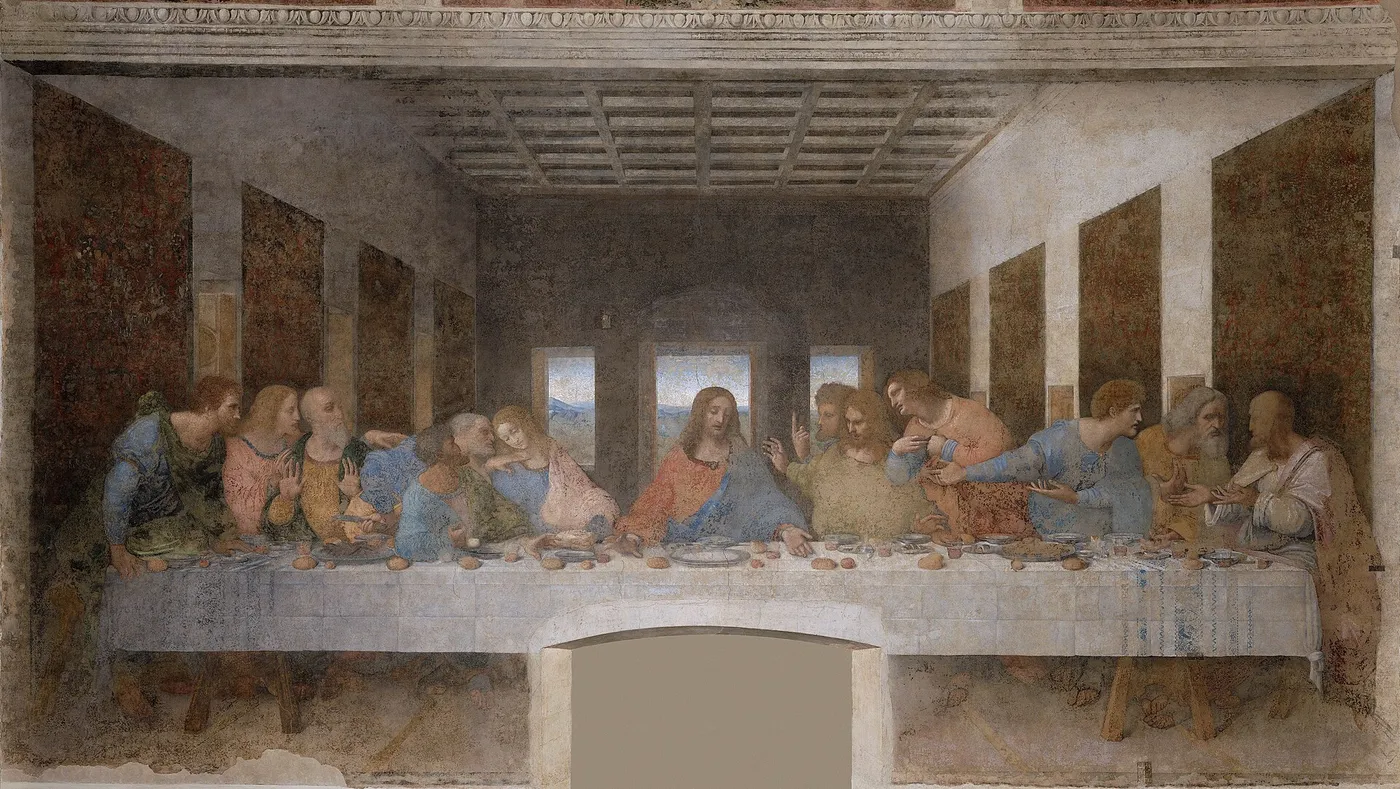
Until then, I hope this helps you think it through, whoever you are and wherever you’re at.
You might have noticed there’s no name here, just my initials. No photo, no employer, no parish. That’s on purpose, and I’d rather just tell you why.
First, this site isn’t about me. It’s about Jesus and the Church he started. If my name and face were all over it, some people would trust it because of me, and some would write it off because of me.
Either way, they’d be arguing with me instead of with the evidence.
I’d rather you argue with the evidence.
Second, to be honest, it’s about safety. These are some of the most heated topics in the world: , the Reformation, Mary. People have been hurt over them for centuries, and online it can still get ugly fast.
This site is open to anyone, anywhere, and some people will strongly disagree with it. That’s fine. That’s the point.
What’s not fine is when someone stops arguing with the ideas and goes after the person instead, or the people around them. I don’t want anyone pulled into that.
Third, it’s about you. I want anyone, from any church, to be able to walk through this and feel they were treated fairly.
Once it becomes about a personality, it turns into picking sides. I’d rather keep the focus on the documents, and on Christ.
Being anonymous doesn’t mean I’m hiding from being checked. You still know what matters. I’m Catholic, and I argue from there.
I’m not a priest, a theologian or a historian. I use AI to help me build this. And you can see exactly how every claim is checked.
Every quote links back to its source. If you spot a mistake, email the project and I’ll check it against the original. You just won’t find out where I live or work.
Even the videos I hope to film in churches around the world, when they happen, will be about the churches, not about me.